

Check Engine Light on in your Ford? How to Fix the code P0443
Reviewed/Verified by:

When diagnosing your Ford’s check engine light, the fault code P0443 will often pop up in your scanner. Fix that fault code (Evaporative Emission System Purge Control Valve Circuit) yourself on a Ford Fusion 2013 to 2020 by following along with this guide!
At a Glance
- Code: P0443, EVAP purge control valve circuit
- Usual cause: a failed purge solenoid, or damaged wiring or connector
- Symptoms: check engine light; sometimes a rough idle or hard start after refueling
- Test: power at the connector, solenoid resistance, and whether it holds vacuum
What P0443 means on a Ford
P0443 is stored as Evaporative Emission Control System Purge Control Valve Circuit. The evaporative emissions system traps fuel vapor from the tank in a charcoal canister instead of letting it escape into the air. The purge valve is the solenoid that opens to let the running engine draw that stored vapor in and burn it. P0443 means the engine control module saw an electrical problem in the circuit that operates the valve.
The distinction matters when you are reading other codes alongside it. P0443 is an electrical fault in the control circuit, while codes such as P0441 point to incorrect purge flow and P0455 or P0456 point to a leak in the system. A purge valve that has jammed open mechanically but is electrically sound will usually set a flow or leak code rather than this one.

🔧 Find out what is actually wrong before you pay someone to guess
Dealer level diagnostics at home with the YOUCANIC UCAN-II Pro.
- ✔ Covers most makes and models, including many luxury brands. Send us your VIN and we will confirm your car before you order
- ✔ Reads every module, not just the engine, so you find the faults a basic reader says are not there
- ✔ Commands the car: test a fan or pump, bleed ABS, retract an electronic parking brake, register a battery
- ✔ No subscriptions. Free lifetime updates, so the price you pay is the whole price
- ✔ Backed by real mechanics in the USA you can email before and after you buy
Featured in The Wall Street Journal
How to Troubleshoot Ford EVAP Purge Control Problems

One of the most noticeable symptoms of a P0443 error code is the Check Engine Light coming on. You may also experience poor fuel economy, as the malfunctioning valve can affect how fuel vapors are recycled into the engine. In some cases, the vehicle may have a rough idle, hesitate during acceleration, or have trouble starting due to fuel vapor buildup or improper air-fuel mixture. While these symptoms might seem minor at first, leaving the issue unresolved can lead to more significant engine problems.
To clear this fault code, first check the Purge Control Valve. The valve can be tested using a diagnostic scanner to determine if it’s stuck open or closed. Inspecting the wiring and connectors is also crucial, as damaged wiring can interrupt the flow of electricity to the valve. If the valve is faulty, it can be easily replaced. Additionally, checking for vacuum leaks in the EVAP system is recommended, as leaks can contribute to the problem
What you will need
- OBD-II Scanner
- 8mm Socket Wrench
- Ford Fusion Purge Valve Solenoid
Procedure
- Unlock the vehicle and go to the driver’s seat.
- Connect the OBD-II Scanner to the OBD-II port below the dashboard.

- Turn the ignition switch to the accessories position.

- Go to the diagnostic menu on the scanner.
- Select read codes and check the stored codes.
- The scanner will show faulty code P0443: Evaporative Emission System Purge Control Valve Circuit.
- Turn off the ignition switch.
- Open the hood. Click here for the step-by-step procedure on opening the hood on the Ford Fusion 2013 to 2020.
- Locate the purge valve solenoid on the right side of the engine intake manifold.
- Disconnect the purge valve solenoid’s connector by pressing the clip and pulling the connector out.

- Pull up the blue clip on the hose and push it out to set it to unlock position.

- Detach the hose by pulling it out.

- Remove the two 8mm bolts on the purge valve solenoid using an 8mm socket wrench.

- Pull the purge valve solenoid out of the vehicle.

- Line the new purge valve solenoid into the vehicle and press it in to set it into place.

- Reinstall the two 8mm bolts on the purge valve solenoid.

- Reattach the hose back to the purge valve solenoid and push the blue clip in to lock the hose into place.
- Reconnect the electrical connector of the purge valve solenoid.

- Turn the ignition switch to the accessories position.
- Go to erase codes on the diagnostic menu.
- Select yes and press enter to erase the stored codes.
- Start the vehicle and check if the check engine light is still on.


Ready to take your repairs up a notch?
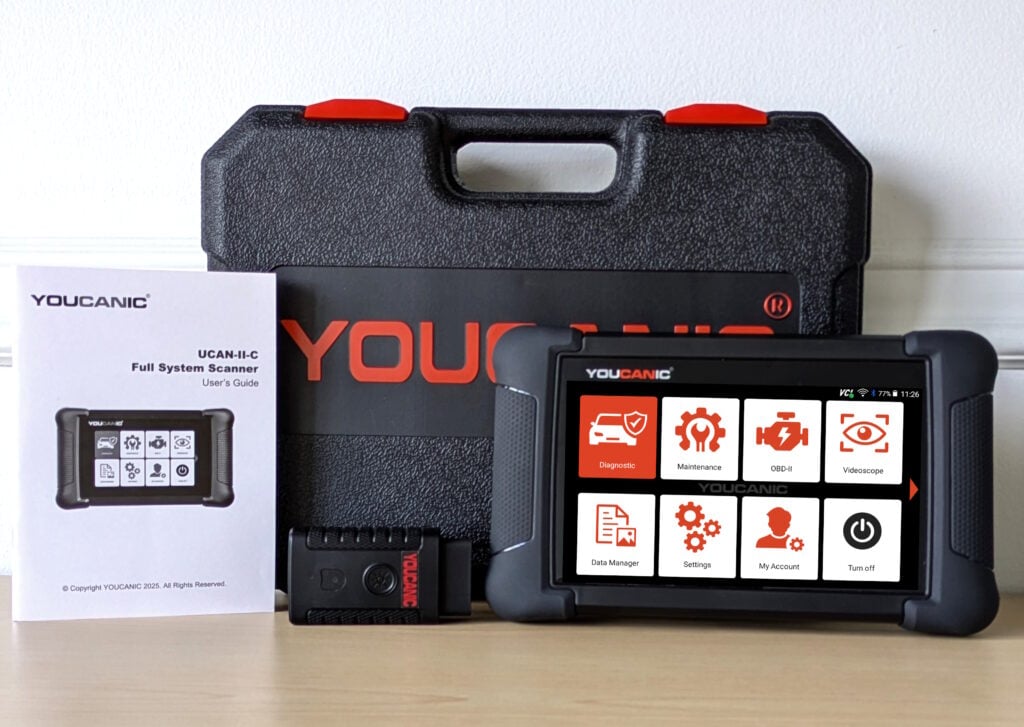
If the Check Engine Light is on after replacing the purge valve solenoid, you can use the YOUCANIC UCAN-II Pro to reset the check engine light. This scanner can also read and clear fault codes in the engine and other control modules on supported vehicles.
Test the solenoid before you replace it
Two checks take a few minutes and will usually tell you whether the valve or the wiring is at fault. First, measure the resistance across the two solenoid terminals with a multimeter and compare it against the figure in your service information. An open circuit or a dead short means the coil has failed. Second, with the valve unplugged and removed, briefly apply twelve volts and a ground directly to its terminals. A working valve clicks audibly as it opens.
If the valve passes both tests, the fault is in the harness between it and the engine control module, or at the connector. Check for a voltage supply at the connector with the ignition on, inspect the pins for corrosion and green deposits, and look for chafed insulation where the harness passes near the intake. Rodent damage to this harness is common because the wiring runs through a warm, sheltered part of the engine bay.
What happens if you ignore it
P0443 will not usually leave you stranded, and many cars drive normally with it stored. The practical consequences are that the car will fail an emissions inspection, the check engine light will mask any new fault that appears afterwards, and fuel vapor that should be burned in the engine is being vented or trapped instead.
A valve stuck in the open position is the version worth attending to sooner. It lets the engine draw fuel vapor continuously, which behaves like a vacuum leak: rough or hunting idle, stalling as you come to a stop, and a noticeably hard start immediately after filling the tank. If those symptoms arrived with the code, do not keep driving it for months.
Clear the code after the repair and drive the car normally for a few days. EVAP monitors only run under specific conditions of fuel level, temperature and steady cruising, so the system may need several trips before it confirms the repair. A full system scanner shows readiness monitor status and lets you command the purge valve open and closed on demand, which confirms the repair without waiting for a drive cycle.
Frequently Asked Questions
What does P0443 mean on a Ford?
P0443 means the engine computer found a fault in the EVAP purge control valve circuit, usually the purge solenoid or its wiring.
Can I drive with code P0443?
Usually yes. It mainly affects emissions, but it can cause a rough idle or hard starting after refueling if the valve sticks open. Fix it to pass inspection.
How do I test the purge solenoid?
Check for power at the connector with the ignition on, measure the solenoid resistance, and apply vacuum to see if it holds when off and opens when powered.


