

How To Fix The Code P0555: Brake Booster Pressure Sensor Circuit
Reviewed/Verified by:

Does your Volkswagen have the fault code P0555: Brake Booster Pressure Sensor Circuit after you’ve scanned it with an OBD-II Scanner? In this article, we will discuss what that fault code means, possible causes, and how to fix it! Are you more of a visual learner? Watch our video guide below!
At a Glance
- Meaning: P0555 is a fault in the brake booster pressure (vacuum) sensor circuit; related codes P0556 to P0559.
- Causes: a failed sensor, corroded connector, damaged wiring, or rarely the engine control unit.
- Also check the booster vacuum hose and the vacuum pump for leaks; low vacuum can mimic a sensor fault.
- A hard brake pedal means lost brake assist; have it checked before driving.
- Test the sensor’s 5 volt reference, ground and signal before replacing it.

The P0555 fault code typically indicates a problem in the brake booster pressure sensor circuit. The brake pressure sensor itself may be faulty; the connectors could be defective or corroded; the wires to the sensor may be damaged; or there is a problem with the Engine Control Module (ECM/ECU/PCM).

In addition to the P0555 fault code, you may see other related codes, such as P0556, P0557, P0558, and P0559. The brake booster pressure sensor monitors the engine vacuum available to the power brake booster; if the sensor is faulty, it could affect other systems.

🔧 Find out what is actually wrong before you pay someone to guess
Dealer level diagnostics at home with the YOUCANIC UCAN-II Pro.
- ✔ Covers most makes and models, including many luxury brands. Send us your VIN and we will confirm your car before you order
- ✔ Reads every module, not just the engine, so you find the faults a basic reader says are not there
- ✔ Commands the car: test a fan or pump, bleed ABS, retract an electronic parking brake, register a battery
- ✔ No subscriptions. Free lifetime updates, so the price you pay is the whole price
- ✔ Backed by real mechanics in the USA you can email before and after you buy
Featured in The Wall Street Journal
Although we will show you how to troubleshoot this problem on a VW, the Diagnostic Trouble Code (DTC) P0555 is a generic code. It can come in any make, including Acura, Fiat, Alfa Romeo, Nissan, Ford, Dodge, Pontiac, Chevrolet, Subaru, Hyundai, Honda, Volvo, Mercedes-Benz, and other makes. The repair procedure will be similar, but the sensor location will vary.
The brake booster pressure sensor circuit detects the vacuum for the power brake booster. The Engine Control Unit (ECU) controls the circuit, which uses the sensor to adapt braking power to various situations and adjust the available vacuum to assist in brake pedal operation.
Symptoms
- The brake light stays on or flashes.
- Check engine light stays on.
- The brake pedal is difficult to press
- The vehicle takes longer to stop.
Possible Causes
- Faulty brake booster sensor
- Cracked or damaged vacuum lines
- Corroded electrical connector
- Damaged wire harness to the sensor
- Faulty brake booster
- Faulty Engine Control Module (ECM)
Possible Solutions
- Replace the faulty brake booster sensor.
- Clean any corrosion built up around the sensor.
- Update, repair, or flash ECU / ECM / PCM.
- Replace damaged wires.
- Replace damaged hoses.
The power brakes use engine-generated vacuum to make slowing the vehicle and applying the brakes much easier. If the brake system has a problem and no vacuum is delivered to the brake booster, applying sufficient brake pressure may be much harder.
Code P0555 typically indicates an electrical circuit fault; the brakes still function, but without diagnosing the problem, it may be challenging to determine the cause.
Troubleshooting with YOUCANIC UCAN-II Pro
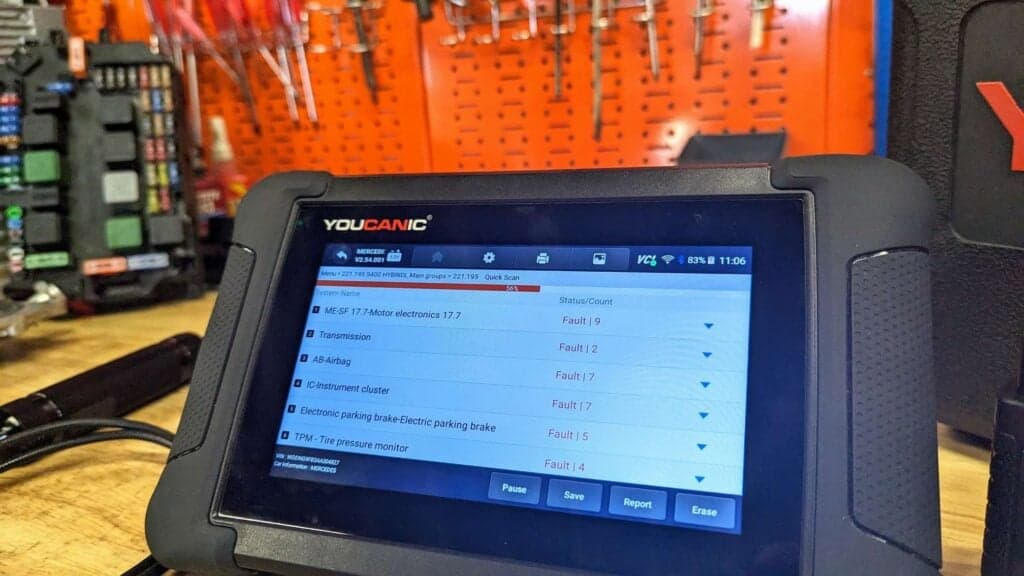
The YOUCANIC UCAN-II Pro is an OBD-II scanner with features belonging to professional-grade scanners. This powerful device can read and clear fault codes, perform bi-directional tests, perform maintenance and repair resets, and many more.
A hard brake pedal changes the priority
P0555 on its own is usually an electrical fault in the sensor circuit and the brakes keep working normally. If the pedal itself has become hard and you have to push much further to slow the car, that is a different problem: the booster is not getting vacuum. On the gasoline TSI and TFSI engines that means the tandem or electric vacuum pump, and on diesels the vacuum pump driven off the camshaft. The car will still stop, but it needs far more pedal effort than you expect and should not be driven far in that state.
Check the vacuum line and check valve before the sensor
The sensor reports what it sees, so a correct sensor reading low vacuum will set this code just as readily as a faulty one. Start with the hose between the booster and the engine, which goes brittle and splits at the elbows, and the one way check valve pushed into the booster, which is cheap and a common failure. A split line will usually also give you a rough idle or a lean running code alongside P0555, which is a useful clue that the leak is real rather than electrical.
Look at the wiring before buying the sensor
Circuit codes point at the wiring as often as the component. Unplug the connector and check for green corrosion on the pins, for oil that has wicked up the harness from a leaking cam cover and for chafing where the harness passes over a bracket. Back probe the connector with the engine running and compare the signal voltage against the live data the scanner shows, because a reading that moves smoothly with engine load clears the sensor and sends you back to the wiring.
Clear the code and see whether it returns
P0555 is often stored once after a battery disconnect, a jump start or a period with low battery voltage, and never comes back. Before replacing anything, note the freeze frame data, clear the code and drive the car normally for a few days. A fault that returns with the same freeze frame conditions is real. One that never comes back was a voltage event, and you have saved yourself the cost of a sensor.
Frequently Asked Questions
What does code P0555 mean?
P0555 means the engine computer found a fault in the brake booster pressure sensor circuit, which monitors vacuum in the brake booster.
Is it safe to drive with P0555?
If the brake pedal feels normal, drive carefully to a shop. If the pedal is hard, you have lost brake assist and need much more force to stop, so have it checked right away.
What causes P0555?
A failed sensor, a corroded connector, damaged wiring, or a vacuum leak in the booster hose or pump are the common causes.



thanks a lot lm helped