

BMW Electronic Parking Brake Malfunction
Reviewed/Verified by:

A BMW parking brake failure warning is usually the actuator, and on E chassis cars the worn gears inside it can often be fixed with a repair kit costing $20 to $60. The alternative is a genuine actuator at $749 list, or $834 for the EMF control unit, before labour. Check the battery before either, because low voltage sets this warning on a perfectly good actuator.
At a Glance
- Start by working out which parking brake your BMW has. Most use a separate actuator unit on the rear axle that pulls cables. Some use a motor built into each rear caliper. The repair, the parts and the price are completely different, and the table below sorts it out.
- Most common cause on the actuator type: stripped plastic gears inside the actuator. The motor spins, nothing moves, and the car reports a malfunction.
- Most common false alarm: a weak or unregistered 12V battery. The parking brake is one of the first systems BMW disables when voltage sags, and no part needs replacing.
- Never wind a rear caliper piston back by hand on a car with motors in the calipers. The gearing is self locking. Forcing it strips the gear teeth and turns a brake pad job into a caliper.
- Cost: roughly $20 to $60 for a gear repair kit on the E chassis actuators, against $749 for a genuine replacement actuator and $834 for the EMF control unit at list price, before labor.
Which Parking Brake Does Your BMW Have
This is the question the rest of the job depends on, and it is the one most guides skip. BMW used two arrangements.
Separate actuator unit. One motor and gearbox mounted on the rear axle area pulls conventional parking brake cables. The electronics are built into the unit on many of these. This is the type with the well known plastic gear failure, and it is the type a gear repair kit fits. Confirmed applications and the genuine actuator part numbers:

🔧 Find out what is actually wrong before you pay someone to guess
Dealer level diagnostics at home with the YOUCANIC UCAN-II Pro.
- ✔ Covers most makes and models, including many luxury brands. Send us your VIN and we will confirm your car before you order
- ✔ Reads every module, not just the engine, so you find the faults a basic reader says are not there
- ✔ Commands the car: test a fan or pump, bleed ABS, retract an electronic parking brake, register a battery
- ✔ No subscriptions. Free lifetime updates, so the price you pay is the whole price
- ✔ Backed by real mechanics in the USA you can email before and after you buy
Featured in The Wall Street Journal
| BMW chassis | Genuine actuator part number |
|---|---|
| F10, F12, F13, F06, F25 X3, F26 X4, E89 Z4, I12 i8 | 34216794618 |
| F15 and F16 X5 and X6, F85 and F86 X5 M and X6 M | 34436882007 |
| F01 and F02 7 Series | 34436877316 |
| F07 5 Series GT | 34436874219 |
| EMF control unit, where separate (F10, F12, F13, F25, F26) | 34436887358 |
Motor built into each rear caliper. Each rear caliper carries its own small motor and screw mechanism. There is no cable and no separate actuator, so a gear repair kit does not apply and a failure means a caliper rather than an actuator.
Part numbers vary by build date even inside one chassis code, so confirm any number against your VIN with a dealer parts counter before you order. That call is free and it is cheaper than a returned part.
On the older E chassis units (E53, E70, E71, E72 and E83), the aftermarket gear repair kits are sold specifically for that actuator. That directly answers the question readers keep asking in the comments below: a kit listed for an E70 X5 will not fit an F15 X5, because the two use entirely different actuators.
Where these parts physically sit depends on which type you have. On the cable type, the actuator is mounted at the rear axle, with the EMF control unit either built into it or separate and often located in the trunk. On the caliper motor type there is no cable actuator at all, and the motors are bolted to the rear calipers themselves. When the system detects a fault it refuses to release or apply, and the yellow PARK warning stays lit. The same system and the same failures appear on the 2002 to 2008 Rolls-Royce Phantom.
Symptoms
- BMW parking brake malfunction.
- The yellow PARK light stays on all the time.
- Fault code 600D or 600E in ECU EEPROM DATA.
- The Park brake light will not go off, even when the car is moving.
- Can’t turn off the automatic brake.
- The Orange Brake Light is ON when starting the car.
- The manual release of the parking brake is not working.
These symptoms can affect many BMW models equipped with electronic parking brakes. Including 5-series, 7-series, Z4, X5, i3; chassis such as E70, E65, F10, E66.
How to Reset BMW Parking Brake

First, try a soft reset of the BMW Parking Brake.
- Press and hold the brake pedal.
- Turn on the ignition.
- Press and hold the parking brake (P) button for five seconds.
If this doesn’t work, reset the parking brake module using one of these methods.
Remove the Parking Brake Fuse

Remove the parking brake fuse for at least five minutes. It is located in the trunk’s fuse box and will be marked as P on your fuse chart. It is usually fuse 10, 94 or 129, but the number varies by model, so check the fuse chart for your car.
Disconnect Battery

Alternatively, disconnect the negative battery terminal for at least 15 minutes.
If you disconnect the battery, you do not need to register the battery. Still, your comfort memory settings, such as radio preset, seat memory positions, etc., may need to reset.
If none of the above solutions worked, the next step is to read the Electronic Parking module’s fault codes. A generic OBD2 scanner will not allow you to read fault codes related to the parking brake.
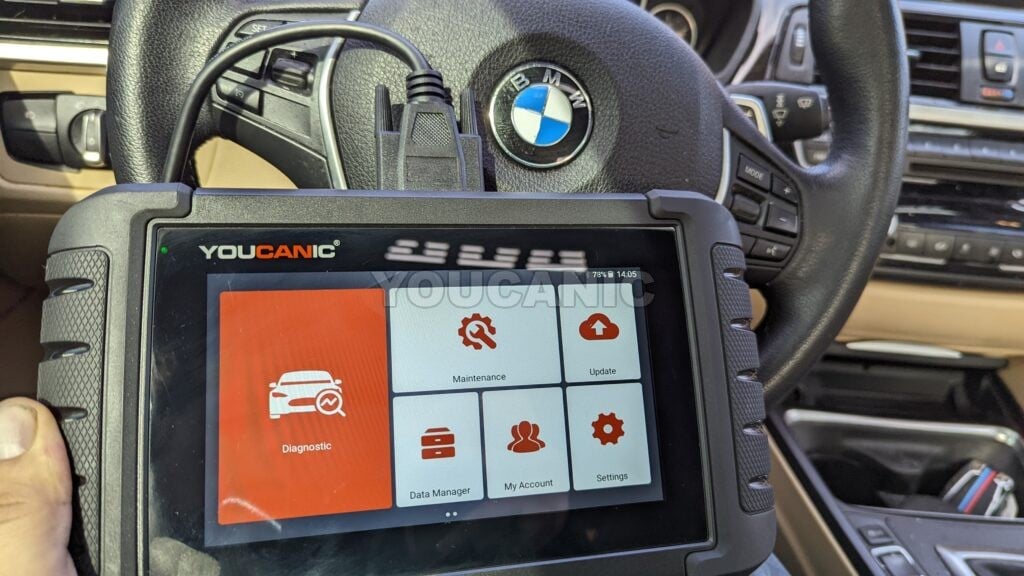
A generic code reader will not help here, because the parking brake codes live in the EMF module rather than the engine module, and most inexpensive scanners cannot address it. What matters more than reading the code is the service function: before you can touch the rear brakes, the actuators have to be driven back electronically into the service position, and afterwards the system has to be recalibrated. There is no way to retract those pistons by hand, which is a separate matter from the emergency release covered further down. The YOUCANIC UCAN-II Pro performs the EMF service position and recalibration on BMW along with reading the module, which is the difference between doing this job and not being able to start it.
Common Problems

The parking brake actuator is the most common problem that causes the yellow BMW PARK light.
- Software issue : BMW parking brake problems, in some cases, can be fixed by performing a software update at the dealer.
- Loose connector : Examine the connector to the parking brake module actuator. A corroded wire can trigger intermittent parking brake errors.
- Weak battery : A weak battery can prevent the parking brake from releasing. You most likely experience other electrical problems if your BMW is not holding a charge. Follow this guide to learn how to replace a BMW battery.
- Parking Brake Actuator : The gear inside the parking brake actuator can break. A common problem on BMW with electronic brakes triggers the yellow PARK light to stay on.
The parking brake actuator can fail, and is one of the most common failures. The gear inside the parking brake actuator that engages and disengages the parking brakes can break.

It is possible to fix the BMW parking brake problem yourself. In about two hours, you can open your old parking brake actuator and install an upgraded BMW Parking Brake Gear Actuator.
You can have the dealer or an auto mechanic fix the BMW parking brake problem. At the dealer, BMW electronic parking brake actuator repair costs over $700.
BMW iDrive Parking Brake Malfunction messages
- The parking brake failed. To park, engage transmission position P. If necessary, carry out emergency release of the parking brake.
- Parking Brake Malfunction Service Now Visit a BMW Dealer for inspection.
- PARKING FAULT ERROR
- Parking Brake Failed Please contact your BMW center.
- Parking brake malfunction. Engage pos. P for the park. If req. Use emerg. Release of the parking brake. Emerg. Braking function, ok.
- Only transmission range D is available. P engages automatically when the engine is switched off.
Check the Battery Before You Replace Anything
A 12V battery that reads 12.6V at rest can still collapse under load, and BMW sheds the parking brake, stability control and hill hold early when voltage drops. A car that throws a parking brake malfunction only on cold mornings, or only after sitting for a few days, is usually telling you about the battery rather than the brake.
Two things matter here, and people routinely do the first without the second. The battery has to be healthy, and it has to be registered to the car. Fitting a battery without registering it leaves the car charging to the old battery profile, which both shortens the new battery’s life and keeps the voltage related faults coming back. A full guide to that step is in how to register a BMW battery.
Load test the battery before anything else. Most parts stores do it free, and it rules out the single most common cause of this message at no cost.
Free Checks Worth Doing in the Driveway
- Soft reset. Hold the brake pedal, switch the ignition on, then press and hold the parking brake button for about five seconds. On a fault that was a one off glitch, this clears it.
- Inspect the actuator connector. It sits in the splash zone under the car and corrosion there produces identical symptoms to a dead motor. Unplug it, look for green or crusty pins, and reseat it.
- Listen when you press the button. A motor that whirrs but never reaches a stop is the classic stripped gear signature. Complete silence points at power, the connector or the module instead. That single observation narrows the job more than any guess.
- Look underneath for a damaged harness. The run near the rear suspension flexes constantly and chafes.
If the Brake Will Not Release and the Car Cannot Move
Contrary to what is often said, these cars are not without a manual way out. BMW supplies an emergency unlocking handle (part 24507590395) on many of the affected chassis, and a dedicated release tool (83302355850) exists for releasing the parking lock. Your owner handbook shows the location for your model, and it is worth finding before you need it rather than after.
Do not try to force or drag a car with an applied electric parking brake. On the caliper motor type you will damage the gearbox inside the caliper, and on the cable type you will stretch or snap a cable. Neither failure is cheaper than a tow.
Service Mode, and Why You Cannot Skip It
Before any rear brake work on a car with motors in the calipers, the parking brake has to be commanded into service position so the pistons retract electronically. The gearing inside is a self locking worm arrangement, which means the piston physically cannot be pushed back the way an ordinary caliper piston can.
Forcing it has three outcomes, and only one of them is harmless:
- Best case: the piston does not move and you have wasted an hour.
- Likely case: the internal gear teeth strip. The motor then spins freely but can neither apply nor release the brake, and the caliper has to be replaced.
- Worst case: the caliper housing cracks and you damage the motor and sometimes its wiring as well.
After the pads are in, the system is taken out of service mode, which drives the motors forward to set running clearance against the new pads and re enables the brake. Skipping that step leaves the clearance wrong.
Both halves are commands sent to the EMF module, not code reads, so an OBD2 code reader cannot do either at any price. That is also why parking brake faults show nothing on a basic reader: they are stored in the EMF module, which is not an emissions module. The YOUCANIC UCAN-II Pro reads BMW EMF codes, commands service mode open and closed, and performs the battery registration covered above. Keep a charger on the car while you do it, because the module refuses these commands at low voltage.
What to do next: the order this job actually runs in
Knowing that you need service mode does not get the pistons back. This is the sequence, and the order matters more than any individual step, because skipping the last two leaves the pad clearance wrong.
- Put a charger on the battery first. The EMF module rejects service commands at low voltage, and a half completed service mode is worse than not starting. Chock the front wheels.
- Connect the scanner and select the EMF parking brake module. This module is not reachable by a basic code reader, which is why your earlier scan showed nothing.
- Read and write down the codes before you touch anything. If the fault is the actuator rather than the pads, you want to know now.
- Run the parking brake service or assembly mode function. You will hear the motors drive the pistons back. Wait for the tool to confirm completion.
- Confirm the pistons have actually retracted before you touch the caliper. If service mode did not complete, do not force the piston. The gearing is self locking and forcing it strips the teeth, which turns a pad change into a caliper.
- Fit the pads.
- Take the system out of service mode. This drives the motors forward against the new pads to set running clearance and re enables the brake. Skipping it is the most common reason the warning returns after a pad change.
- Apply and release the parking brake a few times, clear the codes, then drive and confirm nothing returns.
The YOUCANIC UCAN-II Pro reads the BMW EMF module, commands service mode in and out, and performs the battery registration covered above. It is also available as a seven day rental, which suits this job because most owners need it once. Coverage varies by chassis and year, so email support with your VIN before ordering and we will confirm your car.
When you do not need a scan tool for this
If your BMW has a conventional handbrake lever and cables rather than motors in the rear calipers, none of this applies and the pads come off the normal way. Check which system you have using the table earlier on this page before assuming.
And if the warning appeared on a cold morning or alongside several unrelated messages, load test the battery first. That is free at most parts stores and it is the single most common cause of this message on a perfectly good actuator.
What It Costs
| Who does the work | Typical total cost |
|---|---|
| Battery load test | Usually free at a parts store |
| Battery replacement, fitted and registered | $300 to $550 |
| Gear repair kit for E53, E70, E71, E72, E83 actuators | $20 to $60 for the pair |
| DIY gear replacement, labor | No cost, about 2 hours of your time |
| Genuine BMW actuator, list price | $749 (34216794618) |
| Genuine BMW EMF control unit, list price | $834 (34436887358) |
| Independent shop, actuator replaced | $900 to $1,600 |
| Dealer, actuator and module | $1,800 to $2,800 |
The genuine part prices above are current US list prices from a BMW parts retailer and are the one set of figures on this page that are not estimates. Labor rates vary widely by region, so treat the shop and dealer rows as ranges rather than quotes. A dealer quote near the top of that range is why the gear repair kit is worth understanding before you accept one.
A gear kit is a real repair when the symptom is stripped gears and the motor still runs. It is not a repair for a seized motor, water damaged electronics or a failed EMF module, and fitting one in those cases just costs you the afternoon.
Before You Start
- Chock the front wheels and use jack stands. You are about to disable the parking brake on a car you have lifted.
- Keep a battery charger on the car. The module rejects service commands at low voltage, and a half completed service mode is worse than not starting.
- Work on one side at a time so the other caliper stays assembled as a reference.
- Check your VIN for open recalls before you spend anything. We found no NHTSA recall aimed at BMW electronic parking brake failures, but BMW has recalled other brake parts (for example the brake vacuum pump on 2012 to 2014 3 Series and X3 under 13V454 and 14V627), and any open recall is fixed free. The free lookup is at NHTSA recalls, and a BMW dealer can check it by VIN in a minute.
When to Stop and Hand It Over
- The codes point at the EMF module itself rather than the actuator or a circuit. A replacement module has to be coded to the car.
- The brake has failed applied and the car cannot be moved. Call for a flatbed rather than dragging it.
- You cannot command service mode and the car has motors in the rear calipers. Do not attempt the pads without it.
- The caliper guides are seized, which is a separate and more involved repair than the parking brake fault that revealed it.
- Faults return immediately after a repair with a known good, registered battery.
Frequently Asked Questions
I checked the gear inside the parking brake module, and it is not damaged; what could be wrong?
If the gear is not the problem, check the power going to the parking module motor. The problem could be the ABS module located in the engine bay, passenger side. We recommend reading fault codes from the DSC module to troubleshoot this problem further.
Why does my OBD2 scanner show no fault code for the parking brake?
Many BMW owners try to read parking brake faults using generic OBD2 scanners. These basic scanners can only read Engine Control Unit codes. Parking brake fault codes are not stored in the ECU. They are stored in the EMF module. To read BMW parking brake codes, you will need a BMW-specific scanner.
Where is the BMW parking brake unit located?
In the trunk. Lift the carpet in the trunk. The parking module is towards the front, behind the rear seat. It is located under the trunk, next to the rear differential in some models.
Does the BMW parking module need to be programmed?
No. But fault codes will need to be cleared with a BMW scanner to reset the yellow brake light on the BMW dashboard.
Why am I getting a BMW parking brake malfunction after changing the brake pads?
If you replaced the rear brake pads, you might get a parking light warning on the dashboard. Start the car and pump the brake pedal a few times. Next, check the brake fluid level. Once you have completed these two tasks, operate the parking brakes a few times. That would normally rest your BMW parking brakes. If not, check the sensor at the rear wheels and the cable for the parking brakes.
Related guides: Manually Release BMW Emergency Parking Brake · Top 5 ways you can Complete BMW Battery Registration


2018 is not that old. Not very common but it does happen. That’s crazy expensive. Replace it yourself with a used unit.
Is it common for the emergency brake actuator control unit for a 2018 Bmw X5 xDrive35i to fail and have to have it completely replaced. Why is the dealer charging $2400?
Do you know if the gear repair kit that is linked to above (shows compatibility with 7 series and Rolls Royce) is compatible with E70 X5?
the fuse #10 is located in the cabin under the glove box and the other two fuses(94,129)are located in the rear fuse box.
129)are located in the rear fuse box.
2008 750LI light stays on. AutoP does not work nor will parking brake function. Can hear acuator running sometimes when people brake switch is pushed