

Hyundai Transmission Problems
Reviewed/Verified by:

Hyundai vehicles are known for their reliability and fuel efficiency, but like any other car, they can experience problems with their transmission system. Transmission issues can be frustrating and costly to repair, but you can diagnose and troubleshoot the problem quickly with the right information.
At a Glance
- Six speed automatic: harsh or slow shifts and solenoid codes; Hyundai bulletins cover fluid level, relearn and solenoid fixes.
- 1.6T seven speed DCT: low speed judder; fixed by software and, if needed, an updated clutch.
- 2021 to 2022 eight speed wet DCT: recall 22V746 for loss of drive.
- 2020 to 2021 IVT (Elantra, Accent): slipping campaigns T5B, 963 and 9A9.
- Fluid: SP-IV for the six and front drive eight speed, SP-CVT1 for the IVT, DCT fluid for the DCT. Levels are checked at 50 to 60 °C at a plug, not a dipstick.
One of the most common issues with Hyundai transmissions, affecting even new vehicles, is hard shifting or jerking when the engine is still cold. Once the engine and transmission fluid warm up, shifting is normal after about twenty minutes of driving. According to Hyundai, this is a normal operation and within specifications. We will also discuss the importance of timely maintenance and the use of the right transmission fluid to ensure the longevity and reliability of the transmission system. Whether you’re a Hyundai owner or a car enthusiast, this guide is designed to provide valuable information and help you make informed decisions about the performance and safety of your vehicle.
Symptoms
- Transmission won’t shift or engage.
- Check engine light comes on.
- Hyundai won’t move when placed in Gear / Drive.
- Erratic shifting when cold
- The transmission gets stuck in gear / limp mode.
- The transmission is stuck in Park.
- Vehicle speed is limited to 30mph.
- Transmission between 1st-2nd-3rd gears when cold
Causes
The most common problems with Hyundai transmissions:

🔧 Find out what is actually wrong before you pay someone to guess
Dealer level diagnostics at home with the YOUCANIC UCAN-II Pro.
- ✔ Covers most makes and models, including many luxury brands. Send us your VIN and we will confirm your car before you order
- ✔ Reads every module, not just the engine, so you find the faults a basic reader says are not there
- ✔ Commands the car: test a fan or pump, bleed ABS, retract an electronic parking brake, register a battery
- ✔ No subscriptions. Free lifetime updates, so the price you pay is the whole price
- ✔ Backed by real mechanics in the USA you can email before and after you buy
Featured in The Wall Street Journal
- Low transmission fluid level: Common on Hyundai vehicles with over 100,000 miles. It can cause hard shifts, delayed shifting or shifting at high RPMs.
- Input and output sensor: Failure of either of these sensors will trigger the check engine light and erratic shifting. Hyundai transmission gets stuck in gear. Vehicle speed may be limited to 45 mph maximum.
- Clogged transmission filer: The transmission fluid filter may get clogged by metal shaving, clutch metal, or broken internal parts. Changing the transmission fluid and filter will most likely not fix the problem, and a transmission rebuild or replacement may be necessary.
- Transmission range switch: The switch is mounted atop the transmission housing. It is connected to the shifter in the center console, which changes the transmission gears between Park, Neutral, Reverse, and Drive. This is a common problem in many models, including the 2001 to 2006 Hyundai Elantra and the 2005 to 2009 Hyundai Tucson. It can affect other older models and Hyundai Veloster, Sonata, Genesi, and Santa Fe. The selector may rust and not go in gear or back to Park.
- Torque converter or oil pump failure: The vehicle won’t move when the shifter is placed in Drive or Reverse. This is not a common problem but can be an issue on high-mileage Hyundai vehicles with over 150,000 miles.
- PCM and TCM Problem: Issues with powertrain and transmission software can cause erratic shifting. Especially when cold or when downshifting. Software glitches can cause harsh shifts at cold starts, especially in the newer 8-speed automatic transmission. This problem affects newer Hyundai vehicles, including Elantra, Sonata, Veloster, Santa Fe, etc.
- Brake light switch : It can prevent moving the shifter out or back to Park. It can also cause intermittent starting issues.
- Shifter : The shifter (gear selector) allows you to select the gear (PRND). When it fails, it can prevent the shifter from returning to Park, or you cannot select the correct gear.
- Neutral safety switch : This can prevent the vehicle start or cause the shifter to get stuck in Park. The engine will not start in Park, but it can start in Neutral.
A number of these Hyundai transmission problems are explained in-depth below.
Hyundai Six Speed Automatic Problems
The six speed automatic (A6 family) is used across the Accent, Azera, Elantra, Santa Fe, Sonata, Tucson and Veloster. Documented issues:
- Harsh or delayed shifts: Hyundai TSB 18-AT-004 has technicians check the fluid level, then time each shift. Shifts over 2.5 seconds get an adaptive reset and relearn; if still slow, the transmission is replaced. TSB 18-AT-004.
- Solenoid codes (P0741, P0743, P0748, P0753, P0758, P0763 and related): fixed by replacing the solenoid and valve body harness and refilling with SP-IV. If P0741 returns, Hyundai calls for a new transmission. TSB 20-AT-008H.
- Valve body bore wear, internal harness failures, the fluid temperature sensor and underdrive piston cracks are the weak points transmission rebuilders report. Gears Magazine.
Hyundai Seven Speed Dual Clutch (DCT) Problems
- Low speed judder on 2016 to 2018 Tucson 1.6T, 2015 to 2019 Sonata 1.6T, 2017 to 2018 Elantra Sport and Eco, Veloster and 2018 to 2021 Kona 1.6T. Hyundai’s fix sequence: judder inspection, control unit update, then an updated double clutch and DCT learning if judder continues. TSB 22-AT-007H.
- Delayed engagement from a stop on the 2016 Tucson: recall 16V628 reprogrammed the control unit on about 41,000 vehicles. Recall report.
- Class action settlement: Wylie v. Hyundai covered 2015 to 2017 Sonata Eco, 2016 to 2017 Tucson and 2016 to 2017 Veloster DCT owners with reimbursement and software updates.
Hyundai Eight Speed Wet DCT Problems
Recall 22V746 covers 53,142 2021 to 2022 Santa Fe, Sonata 2.5T, Veloster N and 2022 Elantra N, Kona N and Santa Cruz. A solder joint on the electric oil pump board can fail and cause loss of drive. Fix: inspection, DCT replacement if code P1C2D03 is stored, software, air bleed and learning. Recall document.
Hyundai IVT (CVT) Problems
- 2020 Elantra: campaigns T5B and 963 for slipping or no acceleration (codes such as P0730, P0741, P1603): control unit update and IVT replacement if needed.
- 2020 to 2021 Accent: campaign 9A9 with the same approach.
- Pressure sensor codes P0845, P0846, P0867 on Elantra, Accent, Kona and Venue: a new oil pressure sensor if the car drives normally, a new IVT if there are drivability problems. TSB 23-AT-010H.
- 2021 Elantra stall after a collision avoidance brake event: campaign 967, control unit update.
These were handled as service campaigns under normal warranty; we found no Hyundai IVT warranty extension.
Troubleshooting Hyundai Transmission Problems
If your Hyundai transmission won’t shift, go in gear, or is stuck in 2nd or 3rd gear, there are a few basic things that you can check yourself. First, check if any open recalls for your Hyundai apply to the transmission. Let’s look at what you can do to troubleshoot a Hyundai transmission.
Stuck in Drive, won’t go back to Park.

Hyundai transmissions are common problems because the gear shifter gets stuck and won’t return to Park. Try this temporary solution:
- Set the parking brake.
- Move the shifter to Neutral.
- Keep the brake pedal pressed, then turn off the ignition.
- Turn the ignition back on.
- Move the shifter to Park.
- Turn off the engine and remove the key.

This problem can be caused by a faulty brake switch, ignition interlock module, or gear range selector on the top of the transmission. If the instructions above do not work, manually override the shifter to move it to the park.
If the shifter will not leave or return to Park, check recall 13V113 (stop lamp switch, 2006 to 2011 models) and 14V434 (shift cable, 2011 to 2014 Sonata) by VIN before paying for repairs.
Check the Transmission Fluid Level
Most Kia and Hyundai automatics built in the last 15 years have no dipstick. Hyundai’s procedure for the six and eight speed automatics:
- If the transmission was drained, add about 5 quarts of the correct fluid.
- Warm the fluid to 50 to 60 °C (122 to 140 °F), read on a scan tool.
- Move the shifter through R, N and D twice, then leave it in P with the engine running.
- Remove the level check plug. The level is correct when fluid flows out in a thin, steady stream.
Source: Hyundai TSB 16-AT-004. Older four speed models with a dipstick use the dipstick method in the owner’s manual.
Inspect gear sector range switch.

The gear range selector is mounted on top of the transmission. This switch is connected with a cable to the shifter inside the car, allowing you to select the gear, Drive, Reverse, and Park. The gear selector can rust, or the cable connecting it to the shifter can also rust.
When this happens, moving the shifter or placing the car in Park is hard. Inspect the gear selector range. Spraying penetrating oil may allow you to shift back into Park. Be cautious not to spray it on the electrical connector next to it. Also, the cable may need to be adjusted.
Read Diagnostic Trouble Codes
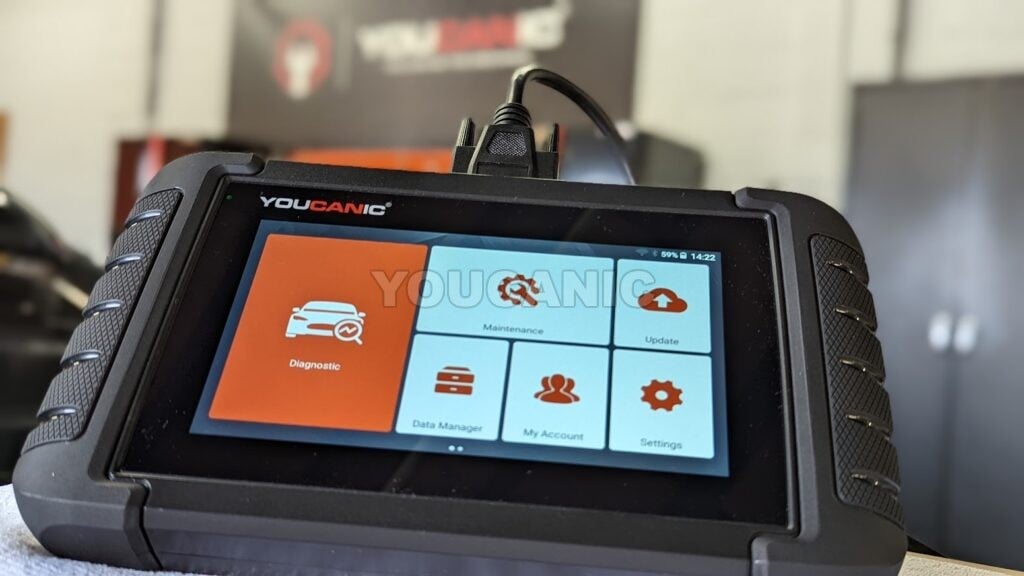
The next step is to read the diagnostic trouble codes (DTC) from the Transmission Control Module (TCM) with an OBD-II Transmission Scanner.
The YOUCANIC UCAN-II Pro can read and clear fault codes through every control module on supported vehicles.
- Locate the diagnostic port under the dashboard.
- Plug your scanner and power it up.
- Turn on the ignition, but do not start the engine.
- Select Hyundai from the main menu.
- Select Control Units > Transmission.
- Scroll down, then select Read Fault codes.
The procedure is similar to reading the check engine light codes. Use a Hyundai transmission scanner to get accurate fault codes and descriptions.
A generic code reader can be helpful but is not recommended as it only shows generic fault codes such as P0700, P0705, and P0740. Reading fault codes from the transmission module will better understand why your Hyundai transmission won’t shift.
You will also be able to view live sensor data from the transmission control module, including data from the input and output sensors, gear shifter position, and more.
Should I use a transmission fix additive?
We do not recommend additives in these transmissions. Hyundai specifies SP-IV for the six speed automatic and warns against other fluids, and additives change friction characteristics that the control unit relies on. Diagnose the code first.
Troubleshooting by Symptoms

Slipping during gear changes or delayed reverse engagement
Older Hyundai cars with A4CF 4-speed automatic transmission suffer from a fairly common problem with gear changes. There will be a noticeable slippage during gear changes between the 2nd, 3rd, and 4th gear.
Other problems included shifting to reverse, which can be delayed and followed by a clunk. These symptoms might be more noticeable when cold. There might be a check engine light and corresponding codes in DTC memory.
Possible causes
- This problem is usually caused by leaking solenoids within the valve body. This is a gradual process, which starts only when cold and gets worse with time. The only solution is replacing the whole solenoid set with new or upgraded ones.
- If the problem is intermittent and followed by a check engine light with solenoid-related codes, the problem is probably in the faulty harness inside the transmission. If the harness is damaged, there is a chance that solenoids are not the source of the problem.
Sudden shifting to Neutral or erratic shifting
Vehicles with four-speed automatic transmissions can suddenly shift to neutral while driving or idling in gear. Although the gearshift is in Drive, it will refuse to engage any gear. In some cases, gear shifts will be very erratic. The onboard diagnostic system memory might have a check engine light and fault codes.
Possible causes
- In most cases, this problem is in transmission input or output sensors, which can go bad. In some cases, this will trigger solenoid-related codes. Replacing them in pairs, an easy job, is the only reliable way of repairing this issue.
Shift flares and delayed gearshifts
Hyundai cars with Aisin AW TF 80 6-speed automatic gearbox, found on models such as the 2006 to 2014 Hyundai Veracruz, can have issues with shift flares during acceleration and delayed downshifts braking, and stopping. Initially, the problem is only present when it is cold and accelerates slowly but it gets worse with time. In most cases, there will be no other symptoms.
Possible causes
- On any high-mileage car, check the service history first. As this transmission is considered ‘sealed for life,’ there is a chance that the transmission fluid was never changed. If needed, perform a detailed flush using only the approved transmission fluid.
- Using a suitable diagnostic tool, resetting transmission adaptation values, and installing the latest software version.
- If the problem persists after performing the steps above, the cause is within worn valve body bores. This causes transmission fluid to leak around the solenoid pistons, resulting in shift issues. Replacing the whole valve body is the only solution, but many specialized workshops sell rebuilt ones because this is a well-known problem.
Burning smell
In some situations, Hyundai cars with four-speed and six-speed automatic transmissions can produce a strong burning-oil smell. In most cases, this will be accompanied by an ‘Overheating transmission’ warning. A burning smell usually happens only when towing a heavy trailer or during long, steep uphills. There will be no other symptoms, and the vehicle will resume normal operation after cooling down.
Possible causes
- As this is a sign of transmission fluid overheating, check its level and condition. If needed, top-up or perform a transmission fluid flush.
- If the fluid changes have been neglected, sludge might be inside the transmission oil cooler. Perform a transmission fluid flush; replace the cooler if it doesn’t help.
No acceleration or very sluggish acceleration
Hyundai cars equipped with a seven-speed dual-clutch (7DCT) transmission can suffer from sudden and intermittent loss of drive. Although the transmission will be in Drive and the engine revving, the vehicle will not accelerate.
In most cases, this happens after a shortstop with the engine running, such as waiting for a red light. There will be no check engine light or other apparent symptoms.
Possible causes
- This well-known problem affects a series of cars and SUVs sold in the U.S, such as Hyundai Sonata, Veloster, i30, Tucson, Ioniq, and Venue.
- This issue is a software glitch, which can cause the transmission to ‘freeze.’ Reprogramming the transmission control unit with updated software solves the problem. A factory recall covered this issue, so check if your vehicle applies.
Shaking during accelerations or harsh shifting
Models equipped with dual-clutch transmissions can develop a series of issues when accelerating. Symptoms can range from delays in response, shaking and juddering while setting off from a standstill, or harsh shifting. Most of these symptoms are more prominent when the driving style is more aggressive.
Possible causes
- These transmissions use a dual-mass flywheel, which can wear out and develop excessive play. This causes a metallic rattle while idling. Check the flywheel condition and replace it if there is any movement between the plates.
- A worn dual-clutch assembly as a result of normal wear-and-tear. Although repair kits allow partial repair, replacing the clutch assembly is usually the best solution.
- Delays in response can result from overheating clutch assembly, which sticks to the flywheel surface. This can happen due to either too aggressive a driving style or outdated software. Update the latest transmission control software using an appropriate diagnostic tool.
- Broken or worn engine or gearbox mounts. This allows excessive movement, causing the engine and gearbox to jump when pulling off from a standstill.
Transmission Recalls
- 13V113: 1,712,336 2006 to 2011 Hyundais. A faulty stop lamp switch can let the shifter leave Park without the brake.
- 14V434: about 883,000 2011 to 2014 Sonatas. The shift cable can detach, so the gear shown may not match the gear engaged.
- 16V628: 2016 Tucson DCT delayed engagement (above).
- 22V746: 2021 to 2022 eight speed wet DCT oil pump (above).
- 23V526: 52,007 2023 Palisade, Kona, Tucson, Elantra and Sonata. The idle stop and go electric oil pump board can overheat; park outside until repaired.
- 24V877: 42,465 2025 Tucson and Santa Cruz with wiring that can interfere with the shift lock.
Check your VIN at nhtsa.gov/recalls.
Fluid Type and Service Interval
| Transmission | Fluid |
|---|---|
| Six speed automatic (A6 family) and front drive eight speed | SP-IV (sold as SP4-M); never SP-III |
| Rear drive eight speed (Genesis, Stinger, K900) | SP-IV-RR |
| IVT (CVT) | SP-CVT1 |
| Seven speed dry DCT | SAE 70W GL-4 DCT fluid |
| Eight speed wet DCT | Dedicated wet DCT fluids |
| Older four and five speed automatics | SP-III (check your manual) |
Current Kia and Hyundai owner’s manuals list “no check, no service required” for the automatic and IVT under normal use, and replacement around 56,000 to 60,000 miles under severe use (towing, heavy traffic, hot climates, short trips). Most US driving qualifies as severe at some point, so the severe interval is a sensible plan. Sources: Kia manual, Hyundai manual.
When Is a Relearn Needed?
- Automatics: Hyundai requires resetting and relearning adaptive values after replacing or reprogramming the transmission or its control module. A routine fluid change is not on that list. Hyundai TSB 16-AT-001-2.
- Harsh or slow shifts: Hyundai’s TSB 18-AT-004 times each shift; a shift over 2.5 seconds gets a reset and relearn first.
- DCT: a separate “DCT learning” procedure follows clutch or DCT replacement.
- IVT: after an IVT replacement or software update, the oil pressure characteristics and adaptive learning must be completed; Hyundai warns skipping it may cause failure.
- The A6 freezes adaptive learning whenever a fault code is stored, so clear the cause first.
What Parts Cost
| Part | Part number | Price |
|---|---|---|
| Seven speed DCT double clutch set (1.6T) | 41200-2D220 | $838 to $1,199 |
| IVT oil pressure sensor | 48885-02300 | $59 to $83 |
| Kia Forte IVT assembly (exchange) | 48000-2H300R | $1,565 to $2,209 plus core |
| Hyundai 2019 to 2020 Elantra IVT assembly | 48000-2H301 | $3,272 to $4,676 |
| Seltos 1.6T DCT control unit | 954A1-2D392 | $640 to $916 |
| A6MF1/A6MF2 valve body with solenoids (aftermarket) | varies | about $190 |
Prices from Hyundai and Kia dealer parts sites in October 2026, parts only. Dealer labor times in the bulletins run about 3.6 to 4.4 hours for a DCT clutch and 3.1 to 3.8 hours for an IVT replacement.
When to Stop and Hand It Over
- Loss of drive or the car goes to neutral while moving.
- Codes return after a correct fluid level and a relearn.
- Your VIN shows an open campaign or recall.
- A DCT or IVT needs internal work.
Reading It Before Authorizing Work
Transmission faults are stored in the transmission control module, which a basic engine code reader often cannot read. The YOUCANIC UCAN-II Pro reads Hyundai transmission codes and live fluid temperature for the level check.
Frequently Asked Questions
How often should Hyundai automatic transmission fluid be changed?
Hyundai often calls the fluid lifetime fill under normal use, but changing it around every 60,000 miles is good practice for severe use, towing or hot climates. Use the exact fluid Hyundai specifies.
Can a software update fix Hyundai shifting problems?
Sometimes. Hyundai has released transmission software updates for harsh or delayed shifts on several models. Ask a dealer to check your VIN for updates before replacing parts.
Is my Hyundai transmission covered by an extended warranty?
Some Hyundai powertrain components carry long warranties for the original owner, and certain models have had campaigns. Check with a dealer using your VIN.
Related guides: Lookup Kia Transmission by Model Year Engine · Most Common KIA Transmission Problems


This post just saved my friend who is 800 miles from home on a roadtrip. Car overheated in 108 degree weather and direct sun. It was refusing to go into gear and they called me panicking. The tip about how to fix the car not going into gear worked first try..
I just bought my 2020 ionic blue with 14,000 miles on it this past Monday. I took it out for the first time driving I have been driving for about three or four hours and getting back on the freeway which was barely an incline it jerked forward several times this little short bursts, and then it stopped, and then when I started to climb the hill, on the freeway it started again. Just short little jerks forward and die. None of the gauges lit up no check engine light and then it remained fine for the rest of my evening which I continue to drive another three or four hours. So immediately I thought maybe transmission problem like I said, I’ve only had the car for not even a week.
My g80 2017 jerks when shifting from 2 to 3 sometimes and 1 to 2 sometimes.
changed fluid/filter
I have Hyundai Entourage 2007 model and I changed the transmission gear, after I changed the gear I noticed that the new gear always jerk on motion when selecting gear 3 or 4.