
Bringing a 2013 Chevy Caprice Police Cruiser Back to Life
Contributed by:

Reviewed/Verified by:

As this Chevy Caprice pulled into the shop’s parking lot, I got the first look at the retired black and white. Even though the decals had all been removed, POLICE was still visible in the faded paint on the doors and hood.

This Caprice was purchased at a Police auction with the intention of making it a daily driver. As is the case with many automotive projects, this sedan was quickly lost in the day-to-day responsibilities and had been ‘sitting for some time now,’ according to the owner.
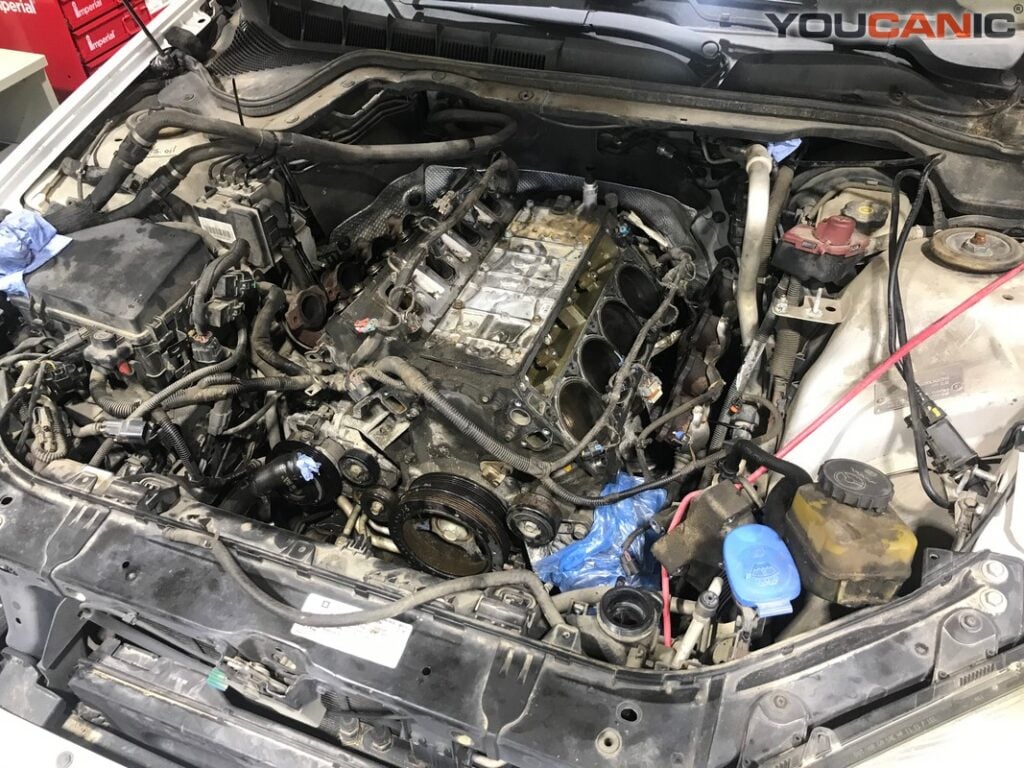
Some progress had been made in restoring the vehicle to its former glory, but a major engine misfire remained. A new battery and 5 gallons of fresh gas were enough to get the Caprice running again, but the 6.0-liter engine was only running on seven of its eight cylinders.

🔧 Find out what is actually wrong before you pay someone to guess
Dealer level diagnostics at home with the YOUCANIC UCAN-II Pro.
- ✔ Covers most makes and models, including many luxury brands. Send us your VIN and we will confirm your car before you order
- ✔ Reads every module, not just the engine, so you find the faults a basic reader says are not there
- ✔ Commands the car: test a fan or pump, bleed ABS, retract an electronic parking brake, register a battery
- ✔ No subscriptions. Free lifetime updates, so the price you pay is the whole price
- ✔ Backed by real mechanics in the USA you can email before and after you buy
Featured in The Wall Street Journal
All the usual suspects had already been replaced on the engine: spark plugs, wires, the ignition coil, and the fuel injectors. Even an unusual suspect, the ECM, had been replaced in hopes of curing the misfire. Despite these valiant efforts, the misfire persisted.

With a scan tool connected to the DLC, I found fault code P0315, “Crankshaft Position Variation Not Learned,” in the ECU. This was due to the ECM having been replaced. After replacement, the ECM must learn the crankshaft rotation characteristics and the crankshaft sensor characteristics for the specific engine for the misfire monitor to function correctly.
The presence of the P0315 code meant there wouldn’t be any accurate misfire date or misfire fault codes. An alternative method for identifying a misfiring cylinder is an RPM drop test. Thankfully, this test is straightforward on the L77 V8 because the ignition coils were readily accessible on the valve covers. Unplugging each coil briefly confirmed that cylinder one was the culprit.

Since all ignition components and fuel injectors had already been replaced, the most likely cause of this engine misfire was a mechanical issue. However, it is best not to assume anything during a diagnosis. Never rule anything out. I checked the ignition spark with a gap tester and inspected the spark plugs; one was wet with fuel. An audible stethoscope test revealed that the fuel injector was clicking and sounded the same as the other injectors. These quick checks further pointed to a mechanical problem with this car.

Next, I ran cranking and running compression tests on cylinder one with a pressure transducer. This testing method allows the pressures inside a cylinder to be viewed as a voltage pattern. The cranking test appeared normal, but the running compression told a different story.

The running compression waveform revealed a valve train issue on cylinder one. There was one initial compression pulse, followed by a complete drop-off in compression. Since this engine was equipped with Active Fuel Management, the likely cause was a collapsing lifter.

Cylinders 1 and 7 on Bank 1 and cylinders 4 and 6 on Bank 2 are equipped with lifters that allow those cylinders to be shut down under certain conditions to conserve fuel. Active Fuel Management is a novel fuel-economy technology, but it has proven problematic over the years. After removing the valve cover to inspect valve springs and performing a cylinder leak down test, I was able to confirm that the problem lay with the lifters.
Once I had an estimate on how much this repair was going to cost and approval from the customer, it was time to get to work. The design of this engine requires that the cylinder heads be removed. After several hours of work, the heads were off, and I could properly examine the suspected components.

Using a borescope camera, I was able to properly inspect the camshaft lobes, which is necessary whenever a lifter is suspected of failure. On this Caprice, the camshaft was indeed heavily worn. Replacing the camshaft was a time-consuming ordeal, requiring the removal of the oil pan, timing cover, oil pump, timing chain, and the front clip to allow enough clearance for the camshaft to be removed from the engine.

The repair continued over several days until the moment of truth. All the parts were reinstalled, and all the fluids were topped off; it was time to bring this V8 back to life. The engine cranked over and fired up. After a brief bit of roughness, the engine smoothed out and ran like it was ready for another high-speed chase! Those days were in the past for this retired Police cruiser, though, a distant memory of more exciting days.

After performing the Crankshaft Variation Relearn with a scan tool and several road tests, the Caprice was delivered back to its grateful owner. The next step was a buff and wax to restore the faded white paint, but that was for someone else to complete; our shop’s work was done.

Do you have a fix to share with our growing community of DIY enthusiasts?
Share your fix with us here! By sharing your fix and having it published on our website, you are encouraging and empowering others to try doing their own repairs. Join the movement and share your fix today!
More guides: browse all of our Chevrolet repair and troubleshooting guides.