
Brake Lights Stuck Always On in Your VW or Audi? Here’s How I Fixed It Without the Dealer
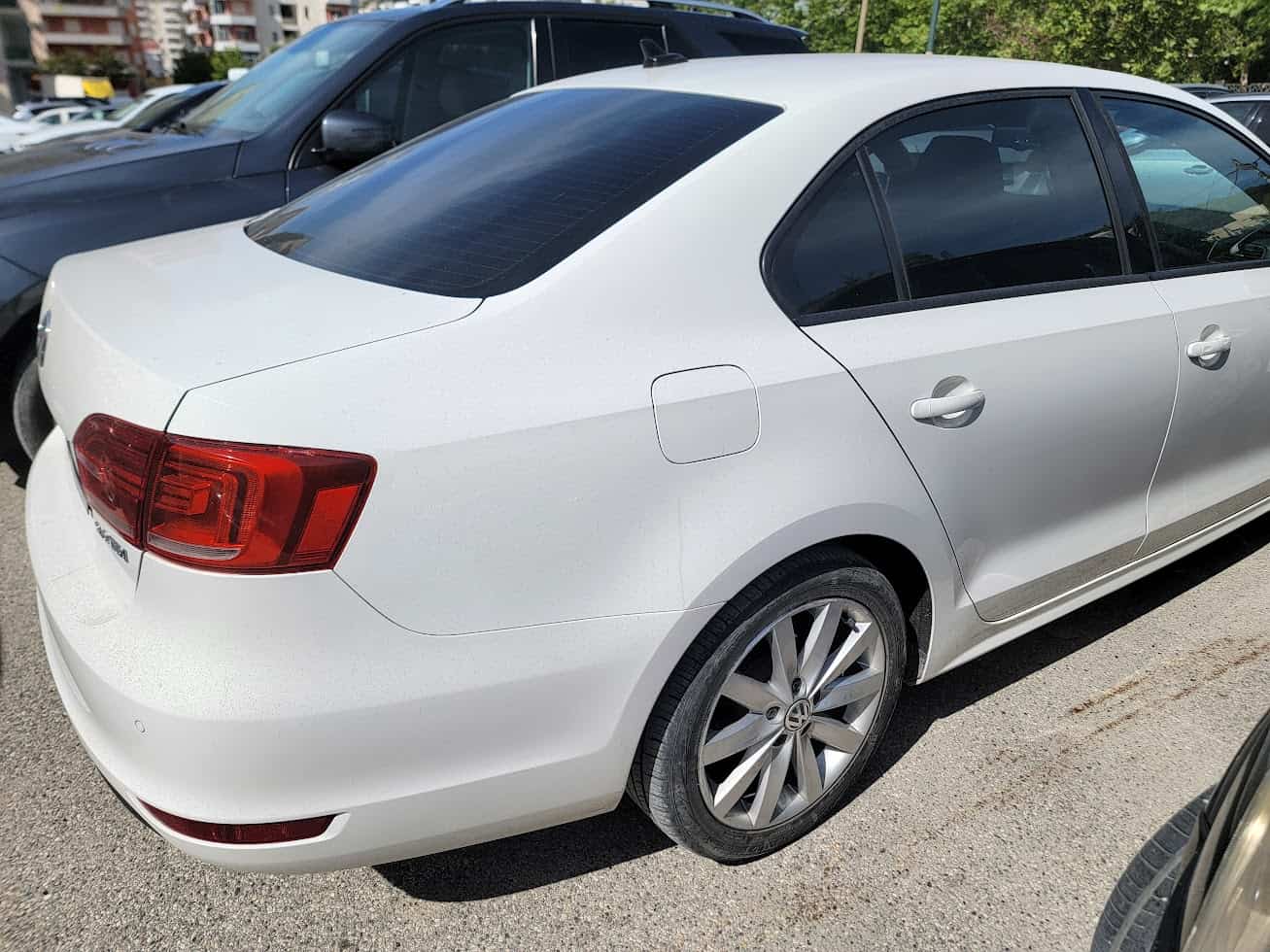
A few weeks ago, I noticed that the brake lights on my 2016 Volkswagen Jetta were always on—even when the brake pedal wasn’t pressed. At first, I thought it might just be a stuck pedal or a simple switch issue. But it quickly became clear this wasn’t your average bulb or pedal spring problem.

The local VW dealership wanted $300 just to diagnose the issue. No repairs—just diagnostics. I wasn’t ready to shell out that money, especially without knowing the real problem. That’s when I decided to take matters into my own hands using the YOUCANIC full system diagnostic scanner. And I’m glad I did—it not only saved me hundreds of dollars, but it also helped me understand a lot more about how modern brake light systems work in Volkswagens and other vehicles in the VAG group (Audi, VW, Seat, Skoda).
Step 1: Scanning the Car with the YOUCANIC Scanner

I connected my YOUCANIC scanner to the OBD2 port and performed a full system scan. In the ABS (anti-lock braking system) control module, I found a very telling fault code:

🔧 Stop paying the dealer for every warning light
Get dealer level diagnostics at home with the YOUCANIC Full System Scanner.
- ✔ Works with all makes and models, including most luxury brands
- ✔ Topology map view shows all vehicle modules on one screen for faster diagnostics
- ✔ Bi directional controls to test fans, pumps, actuators and more so you do not have to guess
- ✔ Special resets and calibrations such as ABS bleed, EPB service, battery registration and more
- ✔ Free lifetime updates with no recurring fees
- DTC: P020E / 00526
- Description: Brake light switch (F), sporadic – implausible signal (008)
At this point, I strongly suspected that the brake light switch was the issue. But here’s where things get interesting—on many cars, the brake light switch is above the brake pedal, easily accessible from the driver’s footwell. That’s where I looked first. However, on the 2016 VW Jetta and many other Audi and Volkswagen models, the brake light switch is a Hall effect sensor mounted on the master cylinder, near the brake booster, in the engine bay.
Step 2: Replacing the Brake Light Switch (And Still No Fix)

I sourced a new brake light switch sensor. The brake light switch on many newer Audis and VWs, including my 2016 VW Jetta, clips onto the master cylinder body.

Replacement was straightforward, but I had to take out the battery, though.
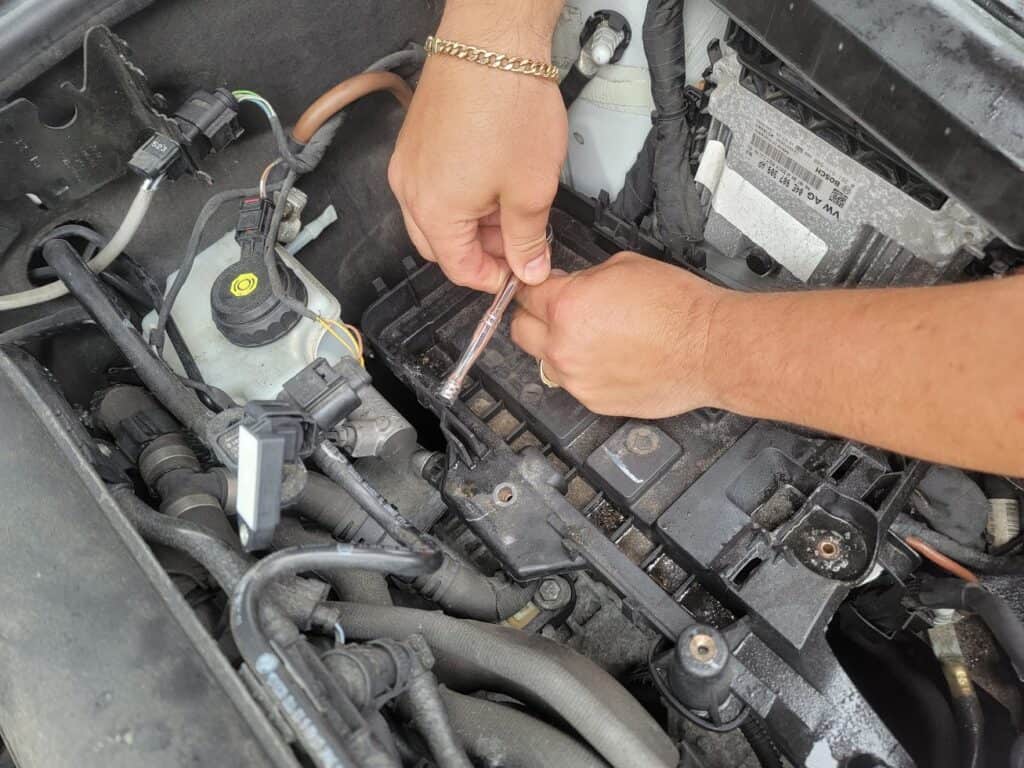
To my disappointment, the brake lights were still on. That meant either:
- The issue was elsewhere in the circuit, or
- The brake light switch sensor wasn’t getting power, or
- There was a short somewhere else in the lighting system.
What made it even weirder was that the car would start without pressing the brake pedal, which isn’t normal.
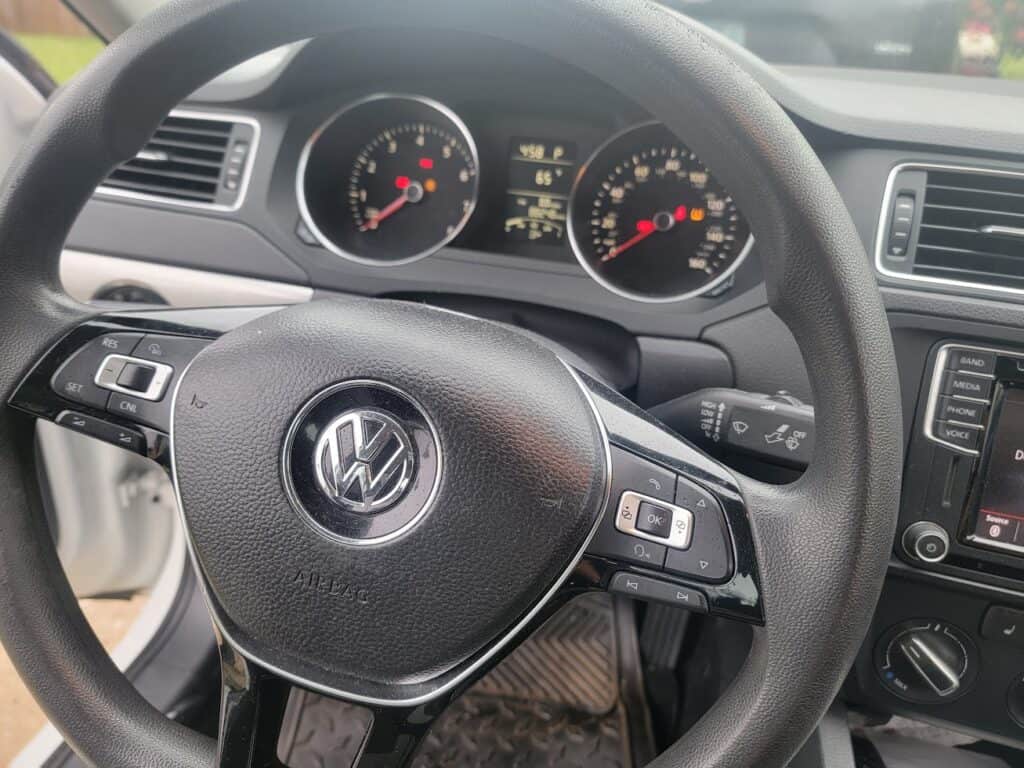
Typically, the ECU needs confirmation from the brake switch signal to engage the starter relay, especially in automatic transmission vehicles.
Step 3: Ruling Out a Short in the Taillight Circuits
I thought maybe a wrong bulb type had been installed at some point and was backfeeding current between the parking light and brake light circuits. This is more common than you might think, especially when dual-filament bulbs are mismatched or installed improperly.
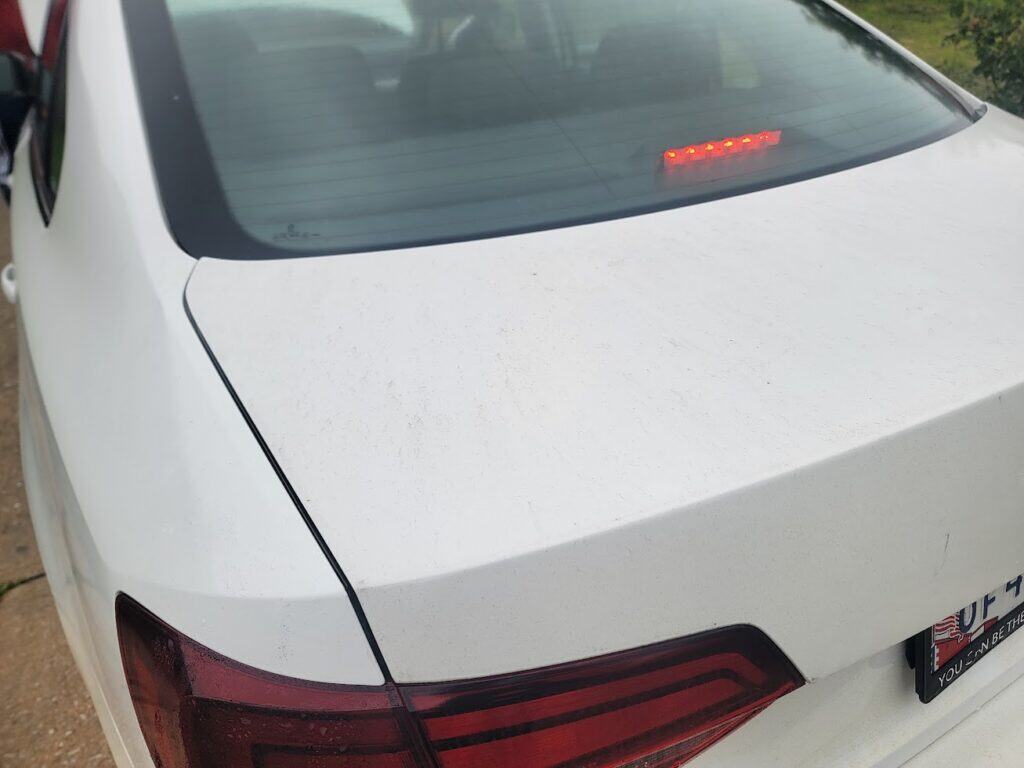
To rule this out, I unplugged the rear taillight harnesses, left and right. But the third brake light (on the rear windshield) remained illuminated. The car also still started without pressing the brake pedal. That ruled out any shorts in the tail lamp assemblies.
Step 4: Checking the Brake Light Fuse
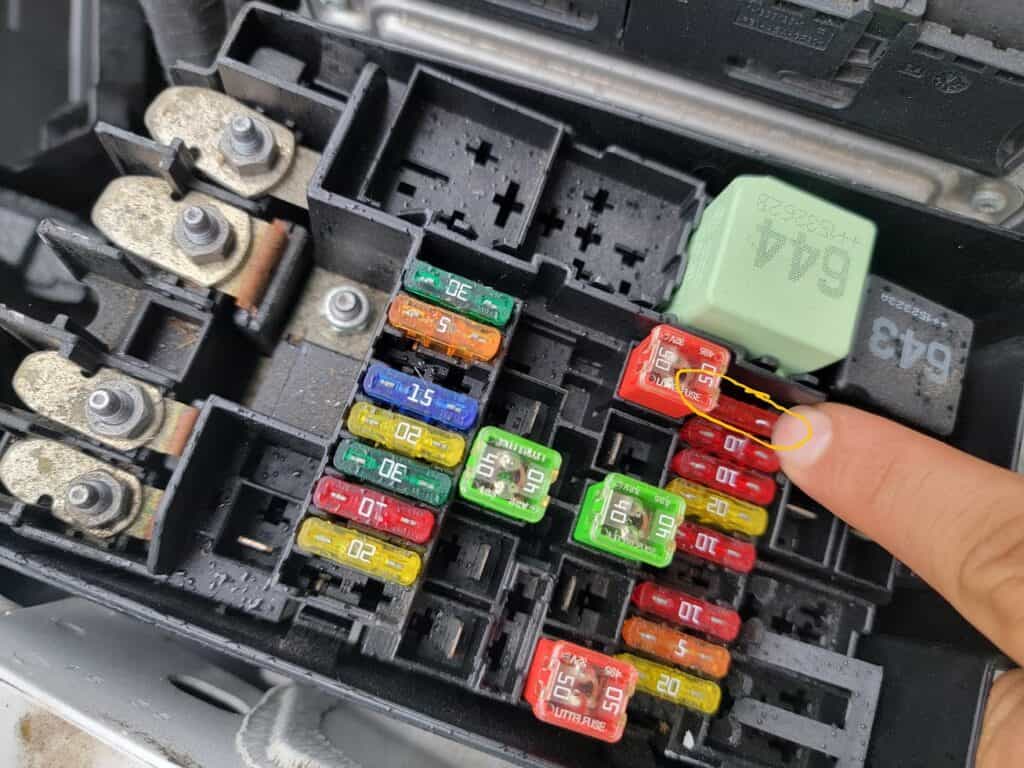
Digging deeper, I used the YOUCANIC scanner to view live data and noticed that the brake pedal position was always reported as “ON”, even when untouched. That’s when I decided to check the fuses.
And bingo.
I found that Fuse F10 was blown in the fuse box under the hood on the driver’s side. According to VW schematics, F10 is a 5-amp fuse labeled for:
Brake light switch / clutch position sender
Once I replaced this fuse with a fresh 5A fuse, everything went back to normal:
- The brake lights finally turned off when they should.
- The live data from the brake switch started showing correctly.
- And the car now required the brake pedal to be pressed before starting, just as it should.
What I Learned – And What You Should Know
Modern cars, especially those made by Volkswagen and Audi, are highly integrated. The brake light switch no longer just controls the bulbs—it also communicates with the:
- ABS module
- ECU (engine control unit)
- Transmission control unit
- Cruise control system
- Start the authorization system
A single blown fuse can trick these systems into thinking the brake pedal is always pressed or never pressed.
The YOUCANIC scanner made a huge difference here. Without it, I would have been guessing blindly. But being able to see:
- Live data from the brake pedal switch
- Stored fault codes in modules like the ABS and Transmission
- And reset the fault memory after replacing the part
…allowed me to pinpoint the issue and avoid unnecessary part replacements or dealer visits.
Other Cars That Share This Design
This isn’t just a Jetta problem. Other VAG vehicles that use the same or similar Hall sensor brake light switch design on the master cylinder include:
- Volkswagen Passat (2012–2018)
- Volkswagen Golf MK7
- Audi A3 (8V platform)
- Audi Q3 and Q5
- Seat Leon
- Skoda Octavia
These models often use electronic sensors for brake and clutch positions mounted in non-obvious places, so relying on visual inspection alone is no longer enough.
Final Thoughts: The YOUCANIC Scanner Paid for Itself
If I had gone to the dealer, they likely would’ve replaced the brake switch ($150+), spent hours diagnosing the issue, and easily charged $500–$800.
Instead, I diagnosed the issue myself in under an hour with the YOUCANIC scanner, spent a few bucks on a 5A fuse, and got my Jetta back in perfect working order.
If you’re serious about maintaining your car—or want to avoid getting ripped off at the dealership—I can’t recommend the YOUCANIC scanner enough. It’s paid for itself many times over.
Tip: Always check your fuses, even the small ones. Always scan your vehicle with the proper tool to access full-system diagnostics, not just engine codes.
Do you have a VW or Audi, or is any modern vehicle acting up? Don’t guess—scan it first.
Hi,
That is a fair question. A scanner can only report what the vehicle’s control modules are able to detect and communicate. If a fuse is blown, the affected module or circuit may simply lose power, and in some cases the scanner may only see a communication issue, a voltage issue, or no response from that module instead of a specific blown fuse message.
Some circuits are monitored closely and can set an open circuit code, but many fuse protected power feeds are not monitored that way. If the module has no power because of the blown fuse, it may not be able to report the fault at all. That is why checking fuses manually with a test light or multimeter is still an important step, even when using a diagnostic scanner.
I am little confused as to the system not indicating a blown fuse. It would seem that it would be able to detect that the circuit was “open” and would have flagged that in the diagnostic mode.