Climate Control Module Repair: RAM Truck Owner Finds $2500 Fix in a Single Resistor
Reviewed/Verified by:

A common issue with costly implications on 2015 RAM 1500 EcoDiesel trucks is that the A/C does not work and is completely dead, which means I have no heat or cold air. The controls don’t work at all, which may look like a blown fuse at first, but that is not usually the case with these trucks.
From what I’ve read on the RAM truck forums, this issue appears to be a common problem. According to the Dodge / RAM dealership in my area, to fix this, I need to replace a part of the $1400 A/C module (I am in Canada, and our dollar is going the way of the peso). In addition, the dealer diagnostic costs $250 plus labor per hour. Add to that shop supplies and taxes, and you are out the better part of $2500: all over a resistor that costs less than a penny, so keep reading.
After getting the YOUCANIC scanner, I noticed the HVAC system wasn’t showing up in the scan results. After consulting with YOUCANIC technical support, I got a few pointers and started a systematic diagnosis of the system.

🔧 Find out what is actually wrong before you pay someone to guess
Dealer level diagnostics at home with the YOUCANIC UCAN-II Pro.
- ✔ Covers most makes and models, including many luxury brands. Send us your VIN and we will confirm your car before you order
- ✔ Reads every module, not just the engine, so you find the faults a basic reader says are not there
- ✔ Commands the car: test a fan or pump, bleed ABS, retract an electronic parking brake, register a battery
- ✔ No subscriptions. Free lifetime updates, so the price you pay is the whole price
- ✔ Backed by real mechanics in the USA you can email before and after you buy
Featured in The Wall Street Journal
From a YOUCANIC UCAN-II-B that was not communicating with the HVAC / air conditioner module, I deduced that a module was offline by noting that only that module was not communicating with other modules or the scanner.

The pinout diagram above is for the climate control module connector in RAM trucks 2013 to 2018. This connector attaches to the Climate Control module and is located on the passenger side, A-pillar behind the lower glove box door.
- Ground is pin 14
- Power is pin 1
- Switch is pin 2
- Can + is pin 23
- Can: is pin 24
With the negative test lead in the ground, a probe of pins 1 and 2 should show battery power (~12V), while pins 23 and 24 probes should show ~2.4V. You can rule out bad ground if battery power registers at pins 1 and 2. If ~2.4V at pins 23 and 24, you can rule out an issue with the can bus. This leaves the module itself as the cause, which I decided to open up and inspect.
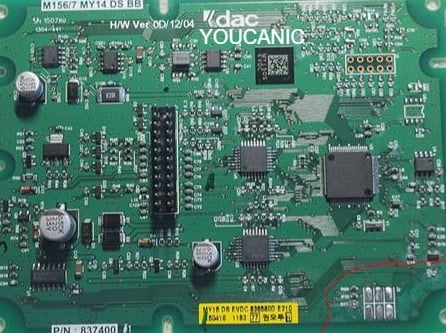
To my surprise, I found the board appeared to have water damage to the lower right quadrant caused by a backed-up sunroof A-pillar drain.
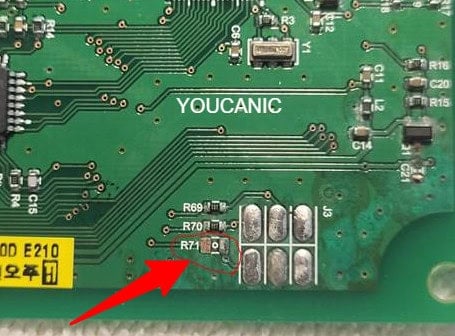
The residue was cleaned with a 99% solution of isopropyl alcohol applied with Q tips. A probe with my multimeter on components of this quadrant revealed that the R71 resistor had failed. All other components in this quadrant tested normal. R71 is a surface-mounted device resistor with “101” stamped on it. It is slightly larger than the two resistors at R69 and R70. The R71 resistor itself is 100 ohms. Of the three digits appearing on the back, the first two digits represent the significant value, and the third digit represents the power of 10 to apply to the first two significant digits.
I’ve contacted an electronic parts supplier for this resistor and am awaiting receipt. I’ll let you know the outcome. In the meantime, I will keep searching junkyards for this module. Once fixed, I plan to seal the module with a flex seal to prevent any future water damage issues. This repair journey shows how a careful diagnostic process can turn a $2500 dealer repair into a simple component fix. Stay tuned for the final results.