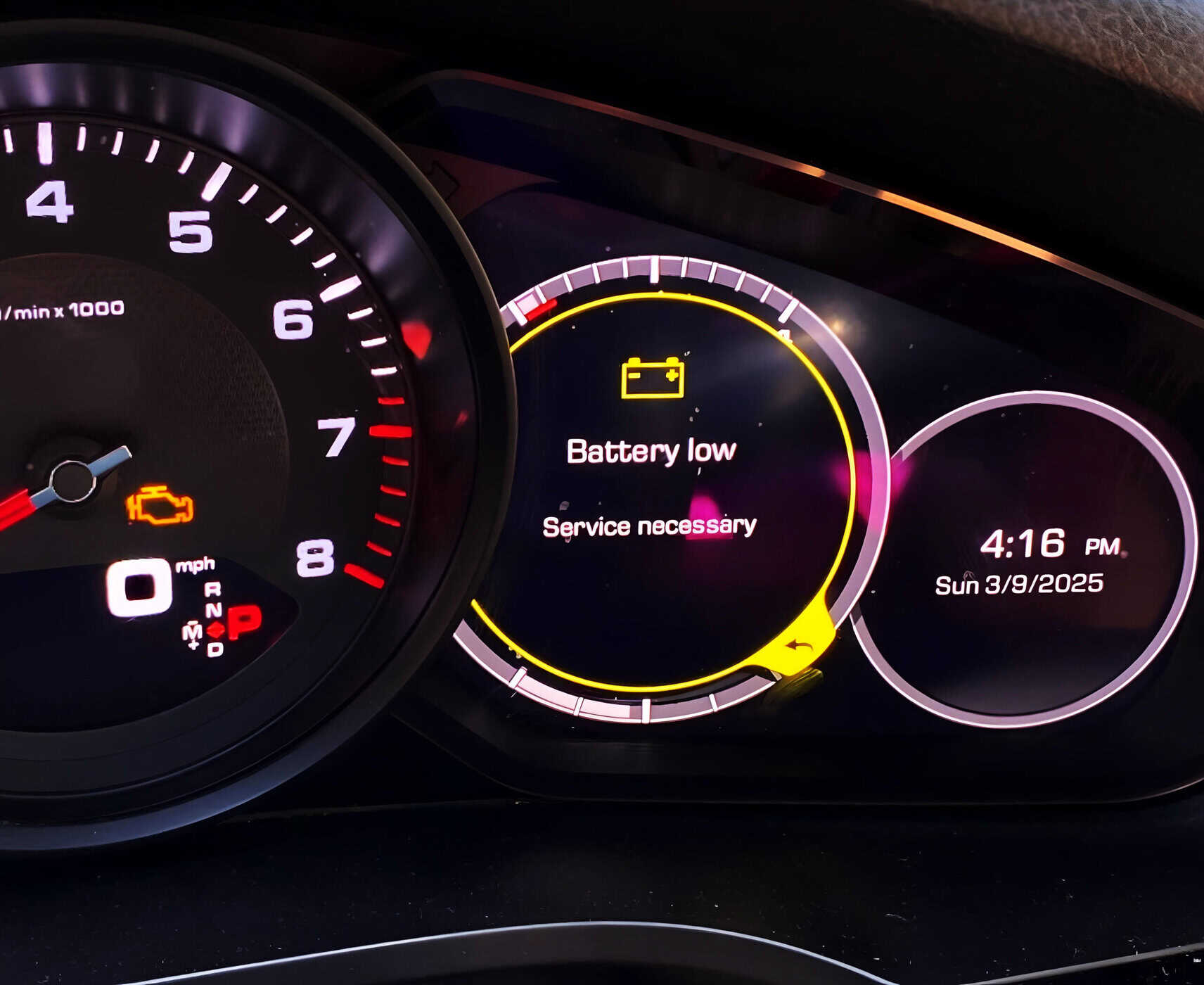
If you see a low battery warning message on the dashboard of your Porsche, it means there is an issue with the battery or charging system that requires immediate attention. Ignoring this warning will cause vehicle electrical failure.
What Does the Battery Low, Service Necessary Message Mean in Porsche?
The battery is the main power supply of electrical components in your vehicle. Every car has an alternator to keep the battery charged while it is running. If a fault message appears, your battery or charging system is malfunctioning.
⚠️ Why You Should Fix It As Soon As Possible:
Safety Risk – It can cause electrical failures, leading to a sudden breakdown while driving.
Performance Issues – Electrical issues can cause hard starting or stall the engine.
Costly Repairs if Ignored – Ignoring the issue may result in battery drainage and electrical failure.
Estimated Repair Cost – The estimated repair cost is approximately $500 – $2,700, excluding towing service.
Common Causes
Defective Battery – A dead or dying battery can cause electrical malfunctions. If the battery fails to hold a full charge and doesn’t send the necessary voltage and current to an electrical component, this will lead to an electrical failure.
Damaged or Loose Battery Cable – Cables usually wear out because of excessive heat and may burn and degrade. The insulator may also be damaged because of aging, which will cause short-circuiting.
Snapped Belt – The alternator runs alongside the serpentine belt. If this belt snaps or slides off, the alternator will not operate and will not charge the battery.
Faulty Alternator / Voltage Regulator – The alternator is your vehicle’s generator. It produces a current that charges your battery when the engine is running. If this component malfunctions, it can lead to overcharging, which could damage other electrical components, or it may not charge the battery at all, leading to a lower voltage reading from the battery.
Blown Fuse or Faulty Relay – Fuses and relays are electrical safety devices that protect components from short-circuiting and overheating. If either one fails or trips, the system may stop functioning.
FaultyBattery Sensor – The battery sensor monitors your battery’s voltage, current, and temperature and sends this information to the control module. If it detects an abnormality, it will send a diagnostic trouble code (DTC), triggering a warning light on your dashboard.
Outdated Software – Outdated software can lead to malfunctioning electrical components. Regular updates are necessary to prevent your vehicle from showing unnecessary warning lights and error messages.
🛠️ Pro Tip: Use an OBD-II scanner to check for error codes related to the issue.
Common Symptoms
Battery Warning Light on Dashboard can sometimes trigger other warning lights – The system triggers a battery warning light if it detects a low battery voltage.
Battery Not Charging – Your battery is not charging either because of a bad battery or a bad charging system. There are other possible issues, but these are the most likely causes.
Hard Starting – Low battery voltage may prevent your vehicle from starting.
Engine Stall – The engine may stall because of an insufficient power supply from the battery, affecting all the electrical components’ ability to operate normally.
Troubleshooting
Before taking your car to a mechanic, try these DIY fixes:
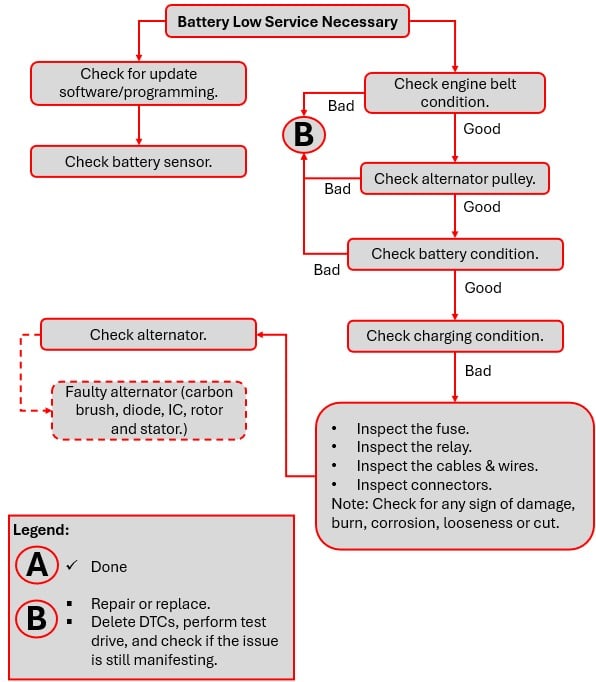
Checking the battery condition – Use a multimeter tool or battery tester to check that the voltage is 12.4V. A battery tester can check the State Of Charge (SOC) and State Of Health (SOH), which will help you better diagnose what is wrong with the battery. (e.g., defective battery, charge the battery, or good battery messages will appear on the screen.)
Check engine belts – Check the engine belt for signs of damage or wear. The serpentine belt wears out over time and must be replaced about every 50,000-100,000 miles.
Check charging condition – Use a multimeter or scanner to check the charging condition of your alternator. To do this, you need to start the vehicle first. After that, read the battery voltage, which should be between 13V and 14.7V, with the engine turned on.
Check fuse – Look for damaged or melted fuses in your vehicle’s fusebox. This could be an indicator of an electrical issue in your car. Check the output of the fuses with a multimeter tool. A good fuse may give you a reading of less than 5 ohms. Only replace old fuses with new ones of the same amperage.
Check relay – Visually check the relay for any signs of burns, corrosion, and damage. Use a multimeter to check terminals 85 and 86 of the relay. A good coil will give you a reading of about 50-200 ohms. Include checking terminals 30 and 87. There must be no reading or “OL.” If terminals 85 and 86 give you a reading of 12V, it will magnetize the contact of terminals 30 to 87, giving you a reading of less than 5 ohms.
Check wires and connectors – Look for any signs of looseness, corrosion, burns, or damage to the wires and connectors.
Check the battery terminals – Look for any sign of looseness, corrosion, rust, burns, or damage to the terminals and cables. Clean the connectors and apply sandpaper for better contact.
Use the OBD-II scanner to scan the vehicle. Check for DTCs using a scanner. Record the history and delete the fault codes. If there is a DTC that cannot be deleted, you will need further troubleshooting because the warning message wasn’t just caused by a glitch in the system. The DTCs will guide you in finding the cause of the issue.
Check the battery sensor – Look for dirt, water damage, and loose wires on the battery sensor, as this could be the reason for the warning message. Over time, the sensor and connectors wear out and might need to be replaced.
Check for any software update/programming – Most of the time, updates and necessary recalibration cannot be done using the OBD-II scanner. Only the dealership will have the tools needed to fix most software errors and update issues.
Seek help from experts if you can’t solve the issue on your own.
Common OBD-II Fault Code
B19E4F0B19E4– Display of battery voltage too low
P0562 – System Voltage Low
P0563 – System Voltage High
U1411 – Control Module Voltage Too Low
C1412 – Battery Voltage Below Threshold
P1602 – Power Supply Voltage Too Low
P068A00P068A – ECM/PCM Power Relay De-Energized Performance – Too Early
P250700P2507– Generator (Alternator) Low Voltage Output
P250800P2508 – Generator (Alternator) High Voltage Output
U015500U0155 – Lost Communication with Instrument Panel Cluster Control Module U010087 – Lost Communication with ECM/PCM “A”
U110100U1101– Battery Monitoring Control Module Communication Fault
P0CA700P0CA7– Hybrid/EV Battery Temperature Sensor Circuit Low
P0CA800P0CA8– Hybrid/EV Battery Temperature Sensor Circuit High
Service Bulletin
Porsche has issued Workshop Campaign WMJ9 for 2018–2022 Cayenne (9YA/9YB) models to address a software error in the gateway control unit’s battery sensor, which may incorrectly calculate the aging status of the 12-volt battery, potentially causing premature battery replacement. The campaign requires reprogramming the battery sensor using the PIWIS Tester 3 (software version 40.900.020 or higher), following strict voltage requirements (13.5V–14.5V) to avoid control unit damage. The programming takes approximately 13 minutes and involves using the ‘Campaign’ function and specific code T7P3T, with fault memory readout and erasure afterward. Technicians must document vehicle voltage during the process, and the repair includes 41 TU labor time under damage code WMJ9 066 000 1.
FAQs
Is the alternator considered faulty if it reads 15V above while checking?
➡️If your multimeter tool gives you a reading of 15 volts, your alternator is overcharging your battery. The alternator has a voltage regulator that maintains the charging within acceptable limits. Allowing higher voltage may indicate a faulty regulator, leading to overcharging and electrical failure in your vehicle.
How do I prevent my battery from losing a charge?
➡️Turn off unnecessary electrical loads in your vehicle when not needed. Start your vehicle and let it run for about 30 minutes if it has not been used for two weeks.
Can a defective battery be charged and used again?
➡️No, a defective battery will always fail to charge and will fail to supply enough energy to your vehicle. This will cause the engine to stall or can lead to hard starting.
What should I do if my vehicle stalls due to a faulty charging system?
➡️Stay calm and move to a safe location if possible. Call for roadside assistance for a jump-start or towing service. Alternatively, you can jump-start your vehicle by yourself if you have a jumpstarter handy.
Can I still drive with a faulty charging system?
➡️It is not safe to drive with a defective charging system. The battery will eventually drain, leading to electrical power loss, which can leave you stuck on the side of the road.
Final Thoughts
The low battery warning message should never be ignored, as it could indicate a serious issue with your vehicle’s electrical supply. We don’t recommend driving with the battery error active as that can lead to other problems and warning lights on the dashboard. Following these troubleshooting steps and scanning for fault codes can save time and money while ensuring your car remains safe and reliable. Use a test tool to check the charging system, test the voltage regulator and alternator, and ensure your vehicle has the latest gateway control unit updates.
Experts Who Contributed to This Article
Elbert Nonog, Automotive National Cert., BS Mechanical Eng.
Diagnostic Specialist13+ years of experience
Elbert G. Nonog is an Automotive Technical Writer and Training Manager with over 10 years of experience across major brands including Chevy, MG, Ford, Volkswagen, and Toyota. Rising from technician to leadership roles, Elbert excels at transforming complex automotive concepts into accessible training materials and documentation. His expertise spans conventional and electric vehicle systems, nationwide dealership training, and aftersales operations management. With TESDA certification and pursuing further education from the Technological University of Philippines, Elbert effectively bridges the gap between automotive engineering and practical application for industry professionals and enthusiasts.
rhila, ASE Certified
Diagnostic Specialist15+ years of experience
Rushit Hila is a dedicated automotive engineer with ASE G1 certification and specialized training from an esteemed Automotive Specialty School. His hands-on experience and technical expertise in advanced diagnostics, system integration, and performance optimization make him a trusted voice in the industry.
Searching...
33% OFFFlash Sale — Ends Soon
⭐⭐⭐⭐⭐ 4.8 stars · 247 Verified Reviews
Stop paying $150 every time a warning light comes on.
The UCAN-II-D gives you full system diagnostics, bidirectional controls, and lifetime free updates. One scanner. Own it forever.
Was
$750
→
Now
$499
Save $251
+ Free shipping · No subscription ever
Free lifetime updates included — no annual fees ever