Toyota Parking Brake Malfunction
Reviewed/Verified by:

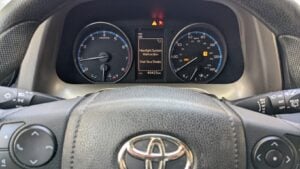
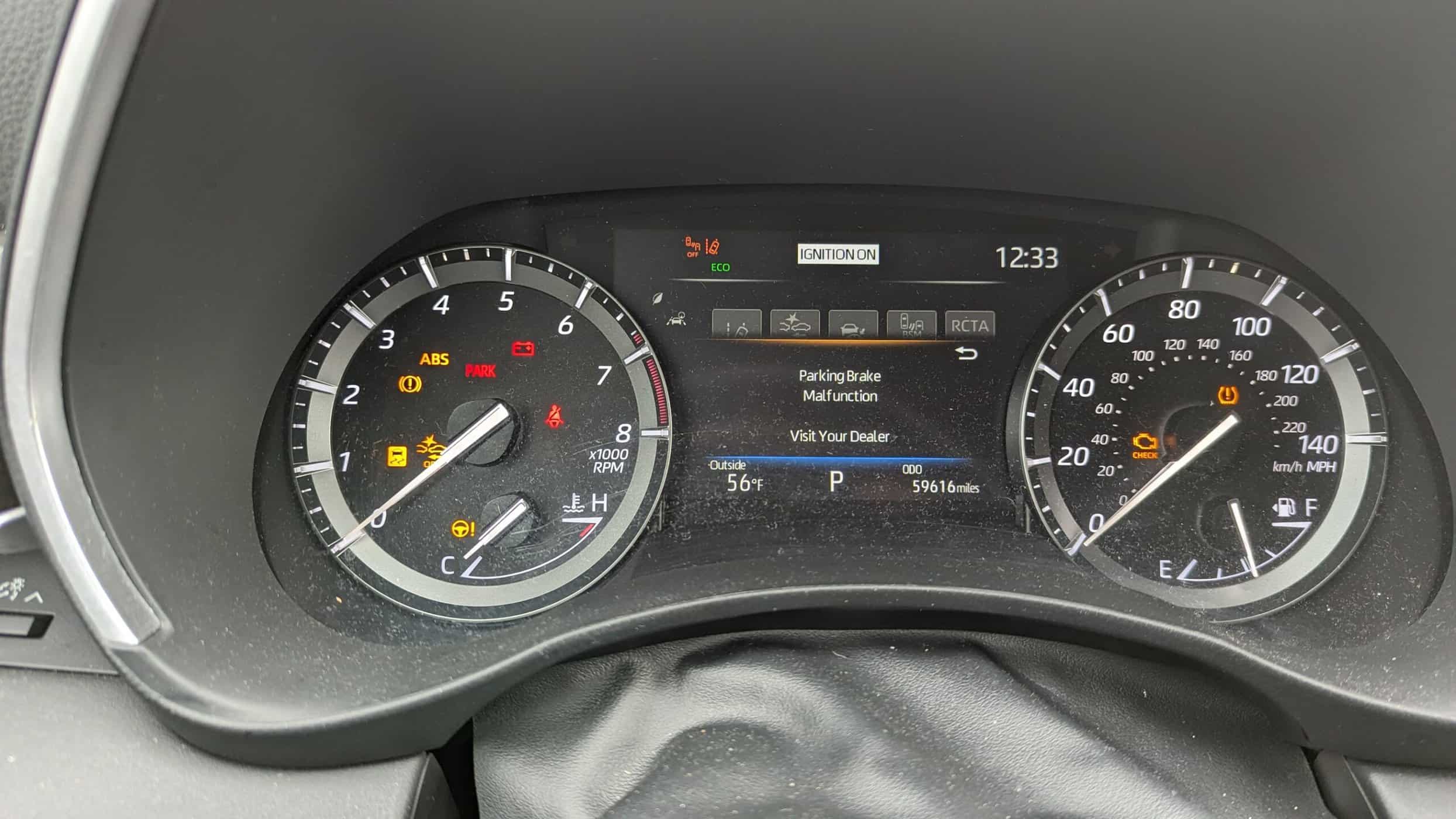
A “Parking brake malfunction” message may appear on the dashboard of a Toyota vehicle when there is an issue with the vehicle’s parking brake system. This message is usually accompanied by a warning light and indicates that the parking brake is not functioning properly.
At a Glance
- Most common cause: a failing electronic parking brake actuator motor at one rear caliper, or corrosion in its connector.
- Second cause: low system voltage. A weak 12V battery triggers this warning on cars with no mechanical fault.
- Third cause: the brake was left applied through winter and the caliper or cable has seized.
- Critical before any rear brake work: the parking brake must be put into service or maintenance mode to retract the actuator. Forcing the piston back without it destroys the actuator.
- Cost: $0 if voltage. $350 to $800 per actuator. $900 to $2,000 for the EPB control module.
The Electronic Parking Brake (EPB) system is an electronically controlled mechanism that locks the vehicle’s brakes when activated. When there is a problem with the EPB, a warning light on the dashboard will be displayed to indicate a fault has occurred in the system. The electric parking brake, also known as EPB, is designed to keep the car from moving when parked. When activated, it applies a force on the rear brake pads to keep the vehicle in place and prevent unintended movement.
What Causes Toyota Parking Brake Malfunctions?

There are a few different things that could cause this message to appear, some of which include a problem with the parking brake actuator, parking brake cable or parking brake switch, a malfunctioning brake control module, or other electronic components.

🔧 Find out what is actually wrong before you pay someone to guess
Dealer level diagnostics at home with the YOUCANIC UCAN-II Pro.
- ✔ Covers most makes and models, including many luxury brands. Send us your VIN and we will confirm your car before you order
- ✔ Reads every module, not just the engine, so you find the faults a basic reader says are not there
- ✔ Commands the car: test a fan or pump, bleed ABS, retract an electronic parking brake, register a battery
- ✔ No subscriptions. Free lifetime updates, so the price you pay is the whole price
- ✔ Backed by real mechanics in the USA you can email before and after you buy
Featured in The Wall Street Journal
If you see this message, it is important to have the vehicle inspected as soon as possible, as driving with a malfunctioning parking brake can be dangerous. Depending on the diagnosis, repairs may include the replacement of the parking brake actuator, brake pads sensor, or brake control module, as well as the replacement of the brake cable and lever or just a brake fluid flush.
Common Problems

Electronic parking brakes, also known as electric parking brakes or EPBs, are becoming more common in Toyota vehicles. Like any other electronic component, they can sometimes experience issues. Here are some of the most common problems with Toyota’s electronic parking brakes:
- Parking Brake Actuator : The actuators mount on the rear axle, right behind the rear brake calipers, and operate every time you press and release the parking switch. The motor can fail and the gear can also break which can lead to the parking brakes not working.
- Weak battery: Another potential cause for the electric handbrake not functioning properly may be a weak battery, which does not provide the necessary voltage to operate the parking brake actuator or power up the parking brake module. It is also important to ensure that all vehicle electronic components are in good working condition. If you replace the car battery or fully charge it the parking brake malfunction should reset if that was the cause.
- Failure to release : One of the most common problems with Toyota electronic parking brakes is that they can sometimes fail to release when the driver wants to move the vehicle. This can happen due to a malfunctioning sensor, a weak battery, or a software issue.
- Failure to engage: On the other hand, the electronic parking brake can also fail to engage when the driver tries to activate it. This usually will happen due to a mechanical issue, such as a worn brake caliper or a problem with the brake actuator. A failed parking brake switch may also be the issue here.
- Warning light: Another common problem is the parking brake warning light appearing on the dashboard. Of course, this could indicate a problem with the brake’s sensor or control module but the problem could also be a bad instrument cluster as well or issues with the ABS module that are not directly related to the parking brake.
- Uneven brake pad wear: Electronic parking brakes rely on brake pads to grip the rotors and hold the vehicle in place. Over time, the brake pads can experience uneven wear, which can affect the effectiveness of the electronic parking brake. This is often due to stuck brake calipers.
- Poor lubrication : If the electronic parking brake mechanism is not properly lubricated, it can cause the brake not to function properly, blow a fuse and make noise.
- Rust : Toyota drivers who never use the parking brake may notice that the parking brake doesn’t work when they try to activate the parking brake. Not using the parking brake on a regular basis can lead to the parking mechanism not being operated for months or even years and can lead to rust building up on the actuator and parking brake cables when applicable. When the driver tries to operate the parking brakes after a long time of no operation, the warning message parking brake system malfunction pops up as the parking brake may be seized or stuck due to rust.
- Software issues: As Toyota electronic parking brakes are controlled by software, they could malfunction because of problems in the software. On certain Toyota models such as the Camry, the Parking Brake Malfunction or Cruise Control Malfunction warning message shows up, and fault code C13B0 is active. To fix this problem take the vehicle to a Toyota dealer to reprogram the Skid Control Computer software. Mention TSB-0168-19. Diagnostic Trouble Code (DTC) C13B0 (Electric Parking Brake ECU Malfunction). Toyota dealers may cover this update under warranty.
It’s important to note that these are just some of the most common problems with Toyota electronic parking brakes and that other issues can occur.
Before replacing the brake pads, it is recommended to put the car in service mode and electronically retract the emergency brakes which can be completed with a YOUCANIC UCAN-II Pro scanner. Once the brake pad replacement is completed, perform an emergency brake reset.
How to reset Toyota parking brake malfunction?
To reset the Toyota parking brake malfunction warning message, perform the following steps:
- Start the car and make sure the transmission is in “Park.”
- Press and hold the parking switch until the parking brake is engaged.
- Turn the car off, wait 5 seconds then restart the engine.
- Press the brake pedal and keep it pressed.
- Press the parking brake switch to release the parking brakes.
- Verify that the parking brake warning light has been turned off.
This procedure should reset the parking brake malfunction on a Toyota. Also if the parking brake is malfunctioning on your Toyota, consider turning off the automatic parking brake mode until the parking brake issue is resolved.
If the warning light stays on, or if the parking brake malfunction message continues to appear, there is still an issue with the parking brake system that needs to be addressed. In this case, it’s best to check the parking brake actuator as that is the most common malfunction, or take the vehicle to a mechanic or Toyota dealer who can diagnose the problem and repair it.
Can I drive a Toyota with a parking brake malfunction?

If the parking brake on your Toyota is stuck in the released position, it may still be drivable. If the parking brake is stuck in an engaged position, the vehicle cannot be driven. It’s important to remember that if you suspect a problem with the parking brake system, it is critical not to drive the car until it has been inspected and repaired by a professional. This can prevent further damage to the brake system and ensure your safety while driving.
How much does it cost to fix a Toyota parking brake malfunction?
If your Toyota’s parking brake is malfunctioning, a trip to the dealership may cost around $150 to $200 for diagnosis alone. If the issue is simply an update needed for the parking brake module, an additional $150 to $200 may be required. However, if the problem lies elsewhere, such as with a faulty Parking Brake Actuator Assembly, the cost can range from $1200 to $2000.
If the vehicle is still under warranty, the dealership should fix the problem free of charge. If your Toyota is out of warranty you may be able to save money by doing some of the troubleshooting yourself.
Troubleshooting

Checking the voltage supply to the braking system is also important. If the system is not receiving the appropriate voltage, it may be due to a problem with the battery or the Electronic Control Unit (ECU). Using diagnostic tools to measure the voltage can help identify any issues.
It’s also important to regularly check the condition of the cables in the EPB system, as they can deteriorate over time and use. Damaged or exposed cables can cause a lack of electrical voltage, which can lead to malfunctions.

To ensure your safety while driving, it’s important to have regular maintenance and inspection of your brake system done by a reputable and reliable workshop. Remember that brakes are the most important safety features in a car, and timely maintenance can help avoid costly repairs and keep you and your passengers safe.
Newer Toyota vehicles have a dedicated parking brake control module. You can use the YOUCANIC UCAN-II Pro scanner to read the codes from the parking brake control module and determine what is causing the problem. The scanner will show you fault codes such as C060e-2a, defined as “Left Electric Parking Brake Actuator Signal Stuck In Range.” and C13B0 Diagnostic Trouble Code (DTC) (Electric Parking Brake ECU Malfunction) which should help you narrow down the issue.
Recall
The National Highway Traffic Safety Administration (NHTSA) announced in 2022 that the redesigned 2022 Toyota Tundra pickup truck and the redesigned 2022 Lexus NX compact crossover had been recalled (NHTSA campaign 22V661) because the Skid Control ECU could falsely detect an overcurrent in the electronic parking brake actuator and stop the parking brake from engaging. The remedy is a free Skid Control ECU reprogram at the dealer (NHTSA recall record). If this sensor malfunctions, the electronic parking brake may not engage properly, which could cause the vehicle to roll away if parked on an incline. This is a serious safety concern as it could lead to accidents.
The recall affects a total of 83,725 vehicles, with 64,330 units being the 2022 Toyota Tundra and the remaining vehicles being the 2022 Lexus NX. However, it is important to note that no hybrid models are included in this recall.
The issue is caused by the electronic parking brake system’s electronic control unit, which could falsely detect an overcurrent, which would trigger the system to shut down to prevent a short circuit and possible fire. As a result, the failsafe in the system will prevent the electronic parking brake from engaging or disengaging. This false read triggers a “Parking brake malfunction, visit your dealer” message in the instrument cluster, and/or it illuminates a malfunction indicator light in the cluster.
To see if your vehicle is involved in a safety recall visit Toyota.com/recall, Lexus.com/recall or nhtsa.gov/recalls or visit nhtsa.gov/recalls.
Try a full ignition cycle first
A good proportion of these warnings are a one off glitch rather than a failed part. Switch the engine off, open and close the driver door so the car fully powers down, wait a minute, then restart and apply and release the parking brake once. If the message clears and stays gone, nothing has failed.
If it returns immediately, note whether it appears only when the brake is applied, only when released, or constantly, because that pattern helps separate a switch or sensor fault from an actuator problem.
Check the battery before buying parts
The electric parking brake draws a heavy current when it cycles, so a battery that still cranks the engine can be too weak to operate it reliably. Low voltage warnings often arrive as a cluster of unrelated messages on the same morning, which is a strong clue the battery is the common cause rather than several separate faults.
If the battery tests good and the message persists, the usual causes are a worn actuator motor on the rear caliper, a damaged harness where it flexes with the rear suspension, or the parking brake switch itself. These log codes in the brake control module rather than the engine, so a generic OBD2 reader will show nothing. A full system scan reads that module directly and will name the circuit at fault.
What This Repair Costs
| Repair | Typical total cost |
|---|---|
| Battery test and replacement | $220 to $400 |
| EPB service mode and reset | $60 to $150 at a shop |
| Actuator motor, one side | $350 to $800 installed |
| Caliper with integrated actuator | $500 to $1,100 per side |
| EPB control module | $900 to $2,000 |
Rough US estimates for planning, not quotes. Prices vary widely by model, parts brand and region, so get a written quote before committing.
The expensive version of this story is someone who wound a rear piston back by hand to change pads and killed a working actuator. Service mode first, every time.
When to Stop and Hand It Over
- The parking brake will not release at all and the car cannot be moved safely.
- Both sides fault at once, which points at the module or the supply rather than the actuators.
- You do not have a tool that can command service mode. Do not attempt a rear pad change without one.
Service Mode Is Not Something a Code Reader Can Do
Putting an electronic parking brake into service position is a command sent to the EPB module. Code readers read. They do not command. This is the single clearest example of the difference, and it is why rear pads on an EPB equipped car are a dealer visit for most owners.
The scanner commands Toyota electronic parking brake service mode, retracts and re seats the actuators afterwards, and reads the EPB module codes that name which side failed. One rear brake job done at home with it saves roughly what a shop charges for the labor alone.
Check the battery before condemning an actuator. A car that throws the warning only on cold mornings is usually telling you about voltage, not about the brake.
Find out which parking brake you have before buying anything
This is the question that decides everything else, and it is free to answer. If your Toyota uses a cable operated parking brake, the repair is mechanical and adjustment is done by hand, with no tool involved at any point. If it uses an electronic parking brake, the actuators have to be put into service position before pads will come out and there is no mechanical shortcut. Establish which one you have first.
For the electronic type, that service function is a command sent to the car rather than a code read from it, which is the line a basic reader cannot cross. If you need it for one brake job, rent one for seven days rather than buying. Email support with your VIN first and we will confirm your model is covered before you order.
Frequently Asked Questions
How can I avoid problems with my Toyota parking brake system?
Use the parking brakes regularly. Regular vehicle maintenance is crucial for the proper functioning of the EPB system. The cables that operate the electric handbrake should be inspected, as well as the brake pads and fluid levels. Any leaks in the brake fluid should be immediately addressed.
Why do newer Toyota vehicles have electronic parking brakes?
The electric parking brake system offers several advantages, making it user-friendly. However, if the system malfunctions, a full system scanner may be required to diagnose the problem, as most newer vehicles have a dedicated parking module.