Ford Ranger 2019: Diagnosing Wipers, Turn Signals, and SRS Failures from One Hidden Problem
Contributed by:

Reviewed/Verified by:

As mechanics, we face dangers every day: cuts, scrapes, burns, and bloody knuckles, to name a few. Don’t get me wrong, underwater welders and lumberjacks need not worry about losing their top spots on the most dangerous jobs list, but there are countless ways to injure oneself while diagnosing and repairing vehicles. After 25 years of wrenching, I thought I had encountered (and survived) all the various hazards of the trade; that is, until a certain Ford Ranger pulled into the shop.
This 2019 Ranger had a litany of electrical concerns. The windshield wipers only worked at high speed, the turn signals did not work, the SRS light was constantly on, the 4X4 control switch was not working, and the steering wheel audio controls did not function. This Ranger also had another unique issue, which brings me back to the new danger this truck posed: mousetraps.

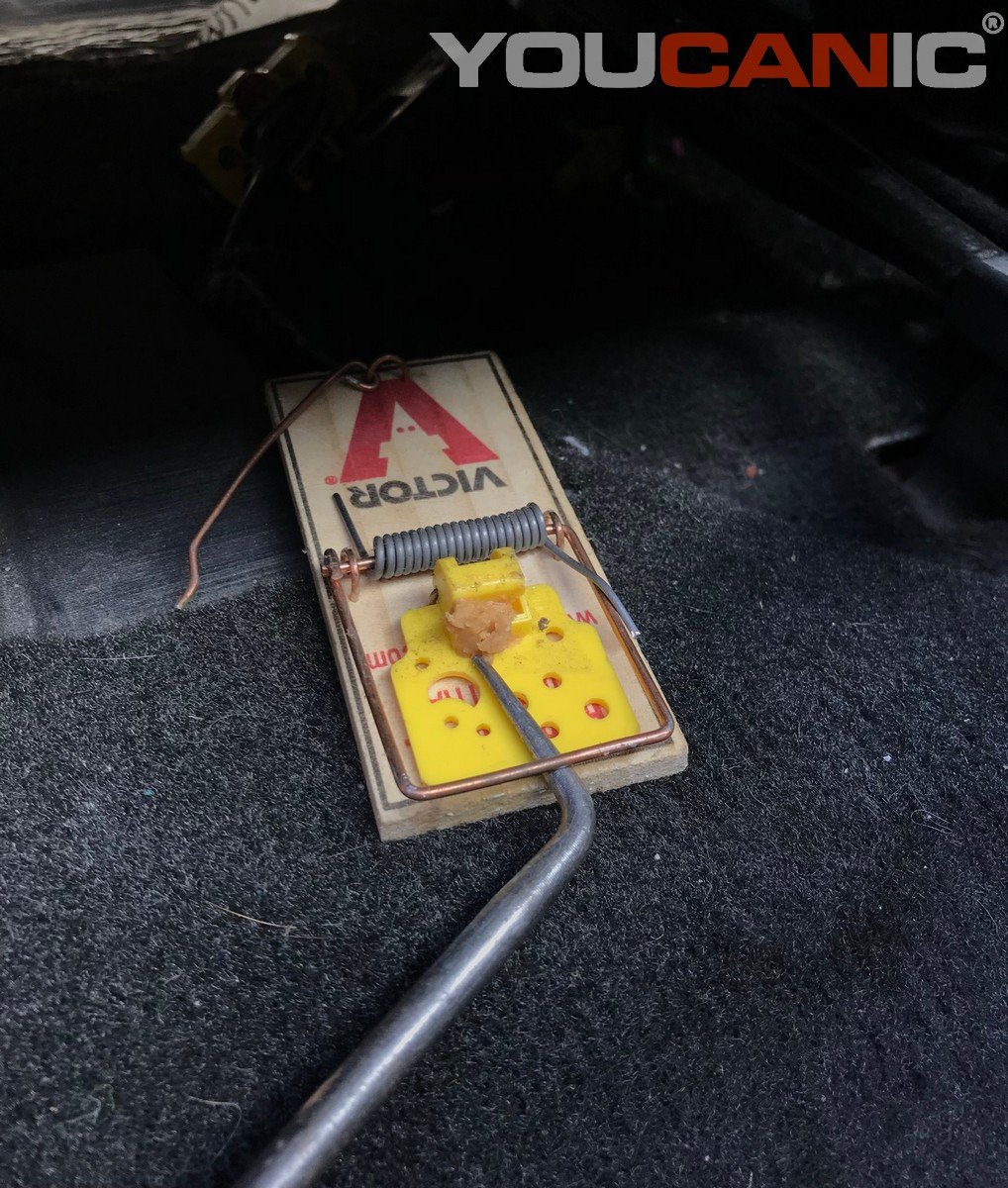
The inside of the truck was littered with them. They were lying on the passenger side and floor, on the back row floor, under the seats, and on the rear seats. They were everywhere. I was not sure why or even how rodents were inside the passenger compartment of this extended cab Ranger; perhaps they were attracted to the fiery red paint job (which Ford aptly named ‘Hot Pepper Red Metallic’). Regardless of why, the mouse traps were a significant clue as to what may be in store as the layers of this diagnosis unfolded.

🔧 Stop paying the dealer for every warning light
Get dealer level diagnostics at home with the YOUCANIC Full System Scanner.
- ✔ Works with all makes and models, including most luxury brands
- ✔ Topology map view shows all vehicle modules on one screen for faster diagnostics
- ✔ Bi directional controls to test fans, pumps, actuators and more so you do not have to guess
- ✔ Special resets and calibrations such as ABS bleed, EPB service, battery registration and more
- ✔ Free lifetime updates with no recurring fees
Normally, a diagnosis should begin by verifying the symptoms the customer described. The Ranger, however, required the additional preliminary step of disarming all the mouse and rat traps. A 45-degree long hook tool was just what the job called for.

With danger averted, the diagnostic process could continue. All the symptoms were verified, and the customer’s description of the issue was accurate. Next, a fault scan was carried out, which yielded important clues. There were multiple communication faults for the Steering Column Control Module (SCCM) and the Occupant Classification System Module (OCSM). These faults were active hard fault codes that could not be cleared from memory.

At this point, given the clear signs of rodent activity, a mechanic’s first instinct would be to start tearing into the dash, looking for damaged wiring or other obvious causes of the problems. This method of exploratory surgery can occasionally yield results; more often, though, it results in a significant amount of time spent removing interior panels and other parts that ultimately must be reinstalled.

Instead, the decision was made to take a look at the CAN Bus signals with an oscilloscope. The SCCM was easy to access by removing two screws from the steering column covers. With the covers removed, channels A and B of the PicoScope were connected to the CAN High and CAN Low wires at pins 4 and 5 of the SCCM connector. The resulting waveform showed CAN High almost mirroring CAN Low with erratic voltages.

There is usually a point during a diagnosis, a fulcrum point, where slowing down can actually speed things up. This may seem like a contradiction, but it works. In the case of this Ranger, ten minutes of time spent reviewing the testing data, CAN Bus wiring diagrams, and critically thinking about the problem saved an hour or more of time that would have been spent blindly taking apart the dashboard and center console.
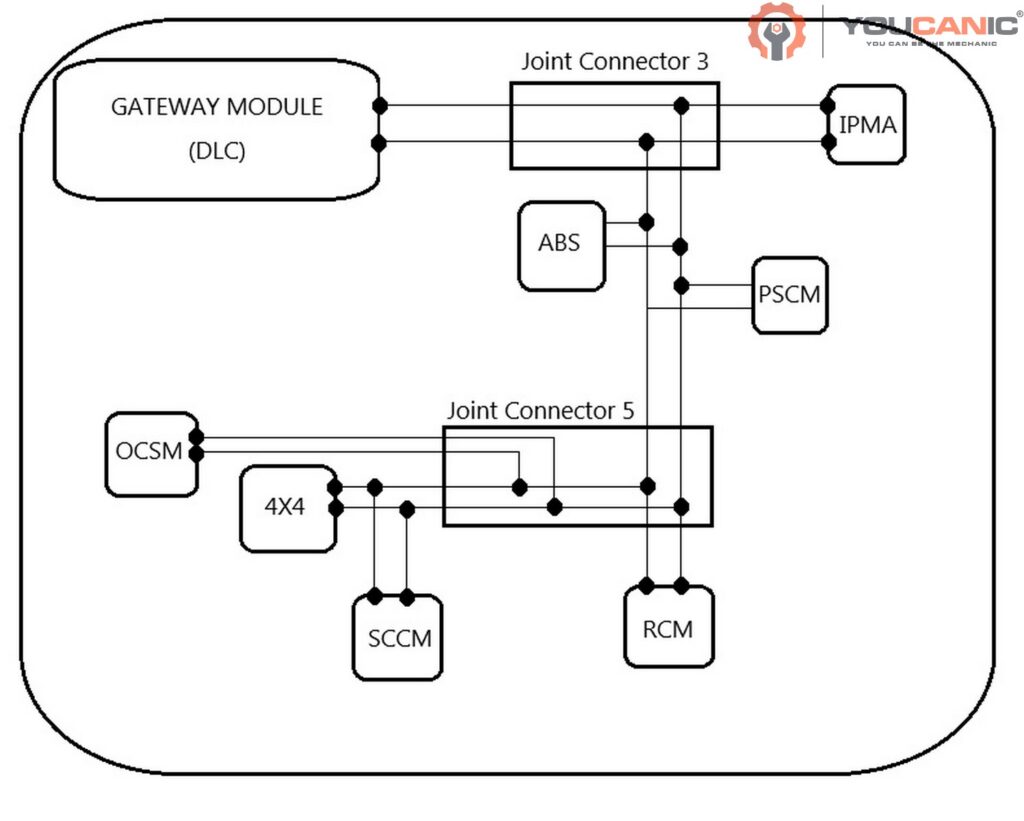
The modules with no communication were all on the High Speed 2 CAN Bus. The CAN Bus signals showed an issue with CAN High, and all the symptoms present on the vehicle could be traced back to the modules that had lost communication. By comparing this information, it was clear where to start looking for the problem: at or near Junction Point 5. All the modules that were not communicating (Steering Column Control Module (SCCM), Occupant Classification System Module (OCSM), and 4X4 Switch Module) were downstream from Junction Point 5. According to the diagram, this junction point was located in the right rear of the cab, under the rear door sill.

This is where the inspection began and immediately produced results. The wire harness directly under the door sill had signs of rodent damage. After opening the harness, the problem was clear; the Green/Orange CAN High wire was chewed in half. The wire was repaired, taking care to maintain the twisted pair configuration of CAN wiring.

With the wiring repair complete, the scan tool was reconnected to the DLC and all faults were cleared. This time, no faults returned. All warning lights were off, and the wipers, turn signals, and 4X4 controls were restored to proper functionality. Repairing this Ranger could have turned into a wild goose chase through the dashboard, steering column, and center console, looking for the damaged wiring. Instead, with some basic testing and critical thinking, the problem area was pinpointed and fixed, resulting in a satisfied customer and shop owner.