

Nissan Crankshaft Position Sensor
Reviewed/Verified by:

A malfunctioning crankshaft position sensor in a Nissan vehicle can cause various symptoms, such as engine misfires, stalling, difficulty starting, and poor performance. We discuss the common symptoms of a faulty Nissan crankshaft position sensor and how to replace it. The Nissan crankshaft position sensor is often confused with the camshaft position sensor, which can also fail and cause engine start problems, but remember it is a different sensor.
At a Glance
- Common codes: P0335 to P0339 for the crankshaft sensor. P0340 is the camshaft sensor, a different part.
- Classic pattern: the car stalls when hot and restarts once it cools down.
- Quick check: if the tachometer needle stays flat while cranking, the engine computer is not seeing a crank signal.
- Check the recall before you buy a sensor. NHTSA campaign 07V527000 covers the 2002, 2005 and 2006 Altima and Sentra with the 2.5 liter engine, and the remedy is a free engine control module reprogram rather than a part. A scanner such as the YOUCANIC UCAN-II Pro shows the live crank and cam signals while the engine cranks.
- Buy by VIN or the old part number, and choose a genuine or recognized brand.

If you scan the engine control module for fault codes, a failing crankshaft position sensor typically stores P0335 most often, and sometimes another code in the P0335 to P0339 range. You may also see P0725, an engine speed input fault, because the transmission relies on the same signal. Note that P0340 is a camshaft position sensor code rather than a crankshaft one. The two are easily confused and they point at different sensors in different places on the engine. This problem is common on the Nissan Altima but affects many Nissan models, including the Quest, Sentra, Maxima, 370Z, Navara, Rogue, Murano, NV200, Micra, Sunny, Qashqai and Serena.
Symptoms
The most common symptom of a failed crankshaft position sensor on a Nissan is that the car hesitates to start or stalls after it starts.

🔧 Find out what is actually wrong before you pay someone to guess
Dealer level diagnostics at home with the YOUCANIC UCAN-II Pro.
- ✔ Covers most makes and models, including many luxury brands. Send us your VIN and we will confirm your car before you order
- ✔ Reads every module, not just the engine, so you find the faults a basic reader says are not there
- ✔ Commands the car: test a fan or pump, bleed ABS, retract an electronic parking brake, register a battery
- ✔ No subscriptions. Free lifetime updates, so the price you pay is the whole price
- ✔ Backed by real mechanics in the USA you can email before and after you buy
Featured in The Wall Street Journal
- Issues Starting the Vehicle.
- Intermittent Stalling.
- Check Engine Light Comes On.
- Uneven Acceleration.
- Engine Misfires or Vibrates.
- Rough Idle and Vibrating Engine.
- Reduced Gas Mileage.
Sometimes, it may require you to crank the car for a long time to get it to start. When a crankshaft position sensor fails, your Nissan will hesitate or may not start at all, and in most cases, the check engine light will turn on.
How to Replace Nissan Crankshaft Position Sensor
Below, you will find instructions on replacing the crankshaft position sensor on a Nissan 3.5L V6 engine.
What you will need
- Nissan Crankshaft Position Sensor
- Mechanic Tool Set
- 10mm socket
- Screwdrivers
- Extension
- Ratchet
- Vehicle Ramps
- Jack Stands
Procedure
Follow these instructions to remove and replace the crankshaft position sensor on a Nissan.
- Jack up the Nissan to access the bottom of the engine. You can use jack and jack stands or ramps, which is easier.
- Secure the vehicle with jack stands.
- Allow the engine to cool down for at least fifteen minutes. Secure the vehicle by placing it in Park. Secure the rear wheels. Place jack stands to support the vehicle.
- Remove the plastic cover from under the engine. It is held in place with several plastic screws.
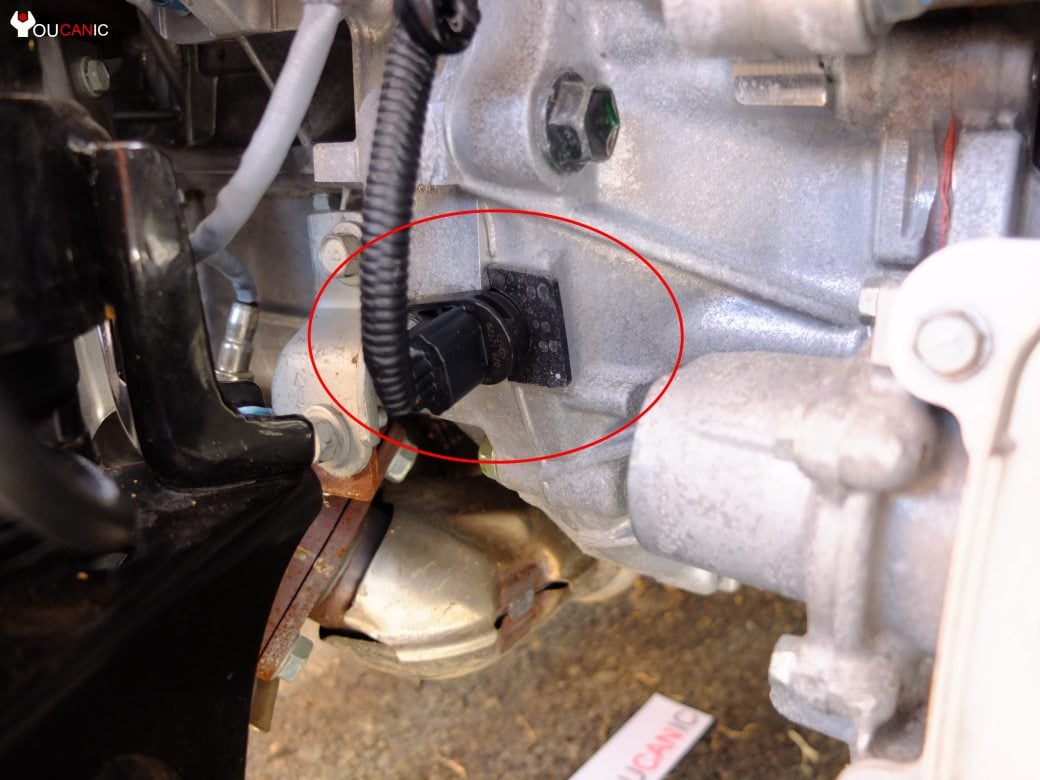
- Locate the crankshaft position sensor on your Nissan. The crankshaft position sensor is installed on the transmission housing where the transmission attaches to the engine block.

- Press the small tab on the connector and unplug the electrical connector by pulling it away from the sensor.
- Remove the 10 mm bolt.

- Remove the old crankshaft position sensor on your Nissan. Install the new crankshaft position sensor in reverse order.
- Once you tighten the 10 mm bolt, reconnect the electrical connector.
- Reinstall the engine splash shield and lower the vehicle.


Troubleshooting
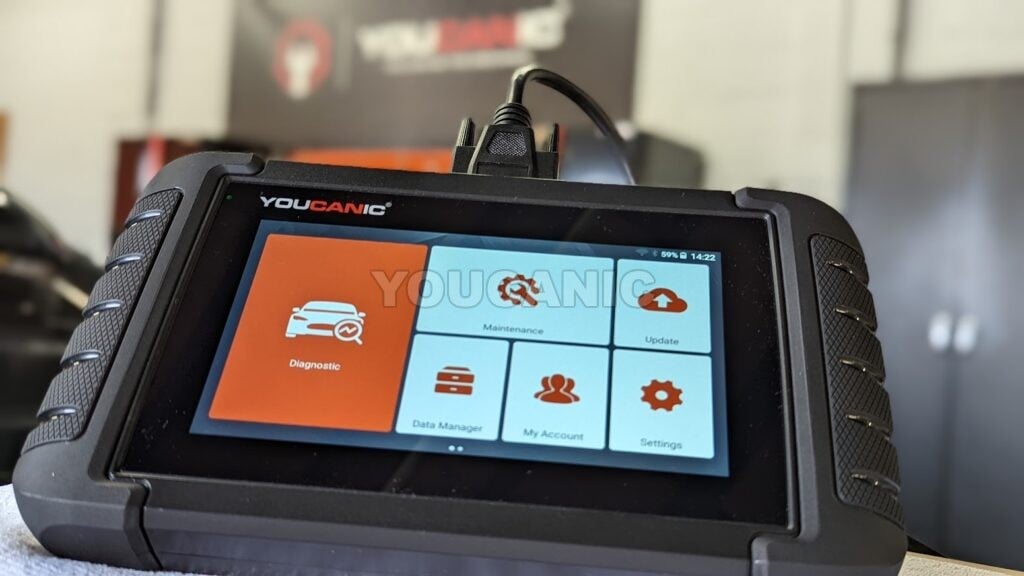
The useful thing a scan tool does here is not reading the code, it is showing you the live crankshaft and camshaft signals while the engine cranks. A failing sensor usually still reads fine cold and drops out once it heats up, so a static code tells you very little and a live reading tells you everything. The YOUCANIC UCAN-II Pro reads that live data on these cars.
The check engine light should reset automatically within a few driving cycles if no other codes are present.
Where is the crankshaft position sensor located on a Nissan?
The Nissan crankshaft position sensor is located on the left side of the engine, where the engine and transmission are bolted together.

How to check if the Nissan crankshaft position sensor is bad?
One of the most common ways to verify that the crankshaft position sensor on a Nissan is bad is to read the ECU’s fault codes. This is a straightforward procedure and requires an OBD2 code reader.
- Plug your scanner into the OBD2 port under the dashboard.
- Turn the ignition on without starting the engine.
- Read codes from the ECU.
- Confirm that a code related to the crankshaft position sensor circuit is present.
Where to buy a Nissan crankshaft position sensor?
Crankshaft position sensors vary by model year and engine, so buy against your vehicle identification number or the part number stamped on the original sensor rather than by model name alone. The list below gives common Nissan genuine numbers along with aftermarket cross references by application. Treat it as a starting point and confirm the number for your car by VIN before you buy. This is one of the components where a genuine or recognized original equipment sensor is worth the extra money, because cheap copies are a well known source of intermittent stalling and of repeat failures within months. Your local parts counter can cross reference the number, and any reputable supplier will accept a return if the number does not match.
Nissan and Infiniti part numbers by application
- 2.5L 4 Cylinder Engine
- Part Number: 235-91203
- Applications: 2002 to 2006 Nissan Frontier, Altima, Sentra
- 3.0L Engine
- Part Number: CKP2085 PC165 714958 SS1013911B1 SS10139 J5T10271 5S1782 2373135U11 2373135U10 2373135U00 2132395 1800319
- Applications: Nissan Maxima, Infiniti I30
- 3.0 or 3.5 V6 Engine
- Part Number: 23731-31U11 PC89 2373131U10 23731-31U10 373131U11 S10113 SU4315
- Applications: Nissan Maxima 1995 to 2001, Pathfinder 2001 to 2002, Infiniti QX4 2000 to 2003, Infiniti I30 1999 to 2001
- 3.5L V6 Engine
- Part Number: 12799167
- Applications: 2002 to 2008 Nissan Altima, Maxima, Quest, Infiniti FX35 I35 G35 350z
- 3.5L V6 Engine
- Part Number: 23731-AL60A 23731AL60C / 23731 AL60C PC499 23731 SU6482 23731-AL60C,1236545
- Applications:
- Nissan Altima (2002 to 2006)
- Nissan Armada (2005 to 2012)
- Nissan Frontier (2005 to 2012)
- Nissan Maxima (2002 to 2008)
- Infiniti FX35 (2003 to 2008)
- Infiniti G35 (2003 to 2007)
- Infiniti I35 (2002 to 2004)
- Infiniti M35 (2006 to 2008)
- Infiniti QX56 (2004 to 2010)
- Nissan 350Z (2003 to 2006)
- Nissan Murano (2003 to 2007)
- Nissan NV1500 (2012)
- Nissan NV2500 (2012)
- Nissan NV3500 (2012)
- Nissan Pathfinder (2004 to 2012)
- Nissan Quest (2004 to 2009)
- Nissan Titan (2004 to 2012)
- Nissan Xterra (2005 to 2012)
- 4.0L V6 Engine
- Part Number: 23731EA20C 23731-EA20A 23731-EA20C 23731EA20C 23731EA20A 23731EA20C 23731EA220 23731EA221 3322082Z30 SU7825 5S6314 PC715
- Applications: Nissan Xterra 2005 to 2014, Nissan Pathfinder 2005 to 2012, Nissan NV3500 NV2500 NV1500 2012 to 2014, Nissan Frontier 2005 to 2014
The symptom that identifies this sensor
A crankshaft position sensor has a very characteristic failure pattern, and recognizing it saves a great deal of guessing. The engine runs normally when cold, then cuts out without warning once it reaches operating temperature, and refuses to restart until it has cooled for twenty minutes or so. The sensor is failing as it heats up and recovering as it cools, which is why the fault appears to come and go.
That pattern is worth knowing because a car that stalls hot and restarts cold is very often diagnosed as a fuel pump, an ignition relay or a crank sensor, and the three are expensive to work through in the wrong order. The quickest discriminator is to check for a tachometer reading while cranking. If the needle stays dead flat while the engine turns over, the module is not receiving a crankshaft signal, which points firmly at this sensor or its wiring.
What a scan tool is actually for on this job
Nissan does not publish a crankshaft position sensor relearn that has to be carried out every time this sensor is replaced, and you should treat any advice claiming the car will idle badly or store misfire codes without one with caution. The learning procedures Nissan does document, idle air volume learning among them, are tied to other work such as throttle body service or engine control module replacement. If a requirement is listed for your specific engine in Nissan service information, follow that. Do not assume one exists because a scan tool advertises the function.
Where a capable scanner genuinely earns its keep here is live data. A crank sensor on its way out usually reads perfectly while the engine is cold and drops out once it is hot, so a stored code tells you very little while watching the crankshaft and camshaft signals during cranking tells you almost everything. If the crank signal disappears at the moment the engine dies, you have your answer without replacing anything on suspicion.
If the code returns with a new sensor fitted, look at the reluctor ring on the crankshaft and at the wiring before buying a second sensor. A chipped or rusted tooth on that ring produces a signal gap the module reads as a fault, and the harness to this sensor sits low on the engine where heat, oil and road debris all reach it.
Check the recall first on a 2.5 liter Altima or Sentra
Before buying anything for a Nissan that stalls at low speed, check this one. NHTSA campaign 07V527000 covers roughly 653,910 vehicles: the 2002, 2005 and 2006 Nissan Altima and the 2002, 2005 and 2006 Nissan Sentra fitted with the 2.5 liter engine. Certain 2006 Altimas already repaired under the earlier campaign 06V223 are excluded from it.
The defect is precisely the fault this page describes. Nissan reported that the crankshaft position sensor can overheat and briefly interrupt its signal output. When that interruption is too short for the engine control module to record as a fault, the engine can stop running without warning at low speed, which is why the campaign was filed as a crash risk rather than a driveability complaint.
The part worth knowing is the remedy. Nissan’s fix was not a new sensor. Dealers reprogrammed the engine control module at no charge so that it tolerates the brief signal dropout instead of shutting the engine down. The campaign opened on December 31, 2007, and recall work does not expire, so an affected car that never had it done is still entitled to the repair. Check your vehicle identification number against the NHTSA recall database, or call Nissan on 1-800-647-7261, before spending money on parts.
What to do next: two free checks before you buy anything
Reading that a crank sensor causes stalling does not tell you whether yours is the problem, and on a 2.5 liter Altima or Sentra it may not be a part you need to buy at all. Work through these in order, because the first two cost nothing.
- Check the recall by VIN. NHTSA campaign 07V527000 covers the 2002, 2005 and 2006 Altima and Sentra with the 2.5 liter engine, and the remedy is a free engine control module reprogram, not a sensor. Recall work does not expire.
- Watch the tachometer while cranking. If the needle stays flat while the engine turns over, the module is seeing no crank signal. That one observation costs nothing and narrows the job immediately.
- Connect a scanner, open live data and put engine speed and the camshaft signal on screen together.
- Crank and watch. A healthy sensor gives an immediate, steady engine speed reading. Zero or an erratic figure points at the sensor, its connector or its wiring.
- Do it hot. These sensors fail as they heat and recover as they cool, which is why a cold test on an intermittent fault proves nothing. Drive it until it dies, then test it where it stopped.
- If the code returns with a new sensor fitted, look at the reluctor ring teeth and the harness before buying a second sensor.
The YOUCANIC UCAN-II Pro reads the engine module live data in steps three to five and clears the stored codes afterwards, and it is available as a seven day rental for a one off job. Coverage varies by model and year, so email support with your VIN first and we will confirm your car before you order.
When you do not need a scan tool for this
Steps one and two need no tool at all, and on an affected 2.5 liter car step one may end the job for free. The tachometer test alone separates a crank signal problem from fuel and ignition.
If you only want to read a stored code, most large United States parts chains lend a basic code reader free. And as covered above, Nissan does not publish a crank sensor relearn, so do not rent a tool expecting to perform one.
What the job costs
An aftermarket crankshaft position sensor for most Nissan and Infiniti engines runs somewhere between twenty five and eighty dollars, with a genuine Nissan part typically in the hundred to two hundred range. On the four cylinder engines the sensor is often reachable from above in under half an hour. On the V6 engines it can sit behind the intake or under the starter, which turns it into a two hour job. Most owners are looking at a hundred and fifty to four hundred dollars at an independent shop, and well under a hundred doing it themselves.
The cheap sensor is a false economy here
This is one of the components where the bargain part genuinely does come back to haunt you. Low cost copies of this sensor are a well documented cause of exactly the fault you are trying to fix: intermittent stalling that returns within a few months, often after the car has warmed up, which sends people back to chasing fuel pumps and ignition switches. Buy against the part number on the original and stick to a recognized original equipment brand.
When to stop and get it diagnosed
If a correct, properly relearned sensor has not fixed the stalling, do not fit a second one. Check the reluctor ring behind the crankshaft pulley for damaged or missing teeth, inspect the connector and harness for oil contamination and chafing, and confirm the camshaft sensor is reading correctly as well, since the engine module compares the two and will fault either if they disagree. A no start or stall that survives a known good sensor is a different problem, and on a car that has already had parts fitted on suspicion, paying for an hour of proper diagnosis is cheaper than continuing to guess.
Frequently Asked Questions
Can a bad crankshaft position sensor cause a no start?
Yes. Without a crank signal the engine computer cannot time spark or fuel, so the engine cranks but will not start. A flat tachometer needle while cranking is a strong clue.
Can I drive with a failing crank sensor?
It is risky. A failing sensor can shut the engine off while driving, which means losing power assist for steering and brakes. Replace it before relying on the car.
Is the crankshaft sensor the same as the camshaft sensor?
No. They are separate parts with separate codes: P0335 to P0339 for the crank sensor and P0340 to P0344 for the cam sensor. Replace the one the code points to.
Should I disconnect the battery before replacing it?
It is good practice. Let the engine cool first too, since on many Nissans the sensor sits near the exhaust or the transmission bellhousing.



First of all, I would like to thank you very much for the useful and detailed and intelligent information you provide to solve sensor problems, and I hope you can help me with my car problem. I had a problem with one of the coils and spark plugs, and before changing them, I cleaned the spark plugs and changed the coils. By chance, I left one of the coils on the metal surface before connecting it. Then my brother started the engine, which caused a spark to come from the coil on the metal surface. After that, the problems started. When I changed the spark plugs to new ones and changed the coils to new ones as well, but when I put the key on, a clicking sound is made in the main fuse box next to the water tank and the fuel pump works. It makes an intermittent sound, not like before, just one sound, but an intermittent and hesitant sound. Finally, the check engine light flashes faster and the engine refuses to start, noting that I changed the battery and the fuel pump, and the same strange intermittent sound remains in the fuse box and the fuel pump. I apologize for the length of time in presenting my problem, but due to the importance of the topic
thank you for this nice tutorial. I found the dealership that “replaced” my sensor installed it with metal debris on the end causing a misfire. Cleaned it with paper towel, reinserted, and voila! purring like a kitten and a terror on the streets.
Causes of ckp. P0335 nissan yd25