

Nissan Change CVT Transmission Speed Sensor
Reviewed/Verified by:

Check the warranty before you buy a sensor. Many 2012 to 2019 Versa, Sentra, Altima, Rogue, Juke and Pathfinder CVTs carry extended coverage of 84 months or 84,000 miles. Then check which codes you actually have: a speed sensor code on its own is one job, but if it arrives alongside a ratio or pressure code such as P0776, Nissan’s own bulletins point at the valve body or the belt instead, and a sensor will not fix that.
At a Glance
- What fails: the primary (input) or secondary (output) speed sensor, very often from a corroded connector. Nissan issued a bulletin for exactly that on the 2014 Rogue.
- Codes: P0715, P0720, P2765 and P0500 point at the sensor circuits. If they come with ratio or pressure codes like P0776, Nissan’s bulletins point to the CVT valve body or belt instead.
- Part cost: about $105 for a genuine primary sensor and $186 for a secondary sensor at dealer online prices.
- Job: one bolt, 5.9 Nm (52 in lb), new O ring, top up with the correct NS-2 or NS-3 fluid. Nissan lists no relearn after a sensor swap.
- Check warranty first: many 2012 to 2019 Versa, Sentra, Altima, Rogue, Juke and Pathfinder CVTs have 84 month or 84,000 mile extended coverage.
The transmission speed sensor on the Nissan CVT automatic transmission may fail, causing shifting problems. Moving the shifter from Park to Drive or Reverse gears can cause hard shifting, check engine light, or a bang.

Symptoms
Signs of bad transmission speed sensor are:

🔧 Find out what is actually wrong before you pay someone to guess
Dealer level diagnostics at home with the YOUCANIC UCAN-II Pro.
- ✔ Covers most makes and models, including many luxury brands. Send us your VIN and we will confirm your car before you order
- ✔ Reads every module, not just the engine, so you find the faults a basic reader says are not there
- ✔ Commands the car: test a fan or pump, bleed ABS, retract an electronic parking brake, register a battery
- ✔ No subscriptions. Free lifetime updates, so the price you pay is the whole price
- ✔ Backed by real mechanics in the USA you can email before and after you buy
Featured in The Wall Street Journal
- Engine bangs (harsh shifts) when placed in Drive / Reverse.
- The Check the Engine Light is On.
- Harsh shifting.
- The cruise control stopped working.
- Possibly Related Fault Codes
- P0720 Fault Code
- P0500: Vehicle Speed Sensor
- P0703, P0705 Range Sensor.
- P0706, P0711, P0712, P0713, P0715.
- P0717 Input speed sensor,
- P0730 incorrect gear ratio.
- Codes that point at the speed sensor circuits include P0715 (input speed sensor), P0720 (output or vehicle speed sensor) and P2765 (input speed sensor B). Ratio and pressure codes such as P0776 point at the CVT itself, not the sensor.
- P0743, P0779, P776, P0746.
What you need
- Nissan CVT Speed Sensor.
- Jack or Car Ramps
- Jack Stands
- 10mm socket, extension, and ratchet.
- 1/4″ socket and ratchet drive recommended.
- 4″ Extension
- A flexible ratchet extension can make getting to the 10mm bolt easier.
Procedure
On some models the sensor can be reached from above after removing the battery and starter; on others, including the Quest shown here, it is easier from underneath. The steps below use the underneath route.
- Jack up the vehicle or drive it on ramps. Secure the car with jack stands.
- Remove the plastic splash shield from the bottom of the engine.
- Locate the transmission speed sensor. In this Nissan Quest, the sensor is on the driver’s side, between the radiator and transmission housing. The black part is the starter. You will need to get under the vehicle to access this sensor.

- Disconnect the electrical connector. Use a flat screwdriver to pry the plug away from the sensor.
- Remove the 10mm bolt. Use your 10mm socket and ratchet to loosen it, then remove the bolt by hand.
- Remove the old speed sensor from the transmission housing. A tiny amount of oil may be leaking from the sensor hole.
- Reinstall the new sensor, making sure the O-ring is in place. Apply a little bit of oil to the O-ring before installation. Reusing the old O-ring is not recommended.
- Tighten the bolt. Nissan specifies 5.9 Nm (52 in lb) for the output speed sensor bolt in campaign PC260; it threads into aluminum, so do not overtighten. Connect the electrical connector.
- Lower the vehicle and follow the proper procedure to check the automatic transmission fluid level.


If the check engine light is still on, plug an OBD2 scanner into the diagnostic port under the cluster (driver’s side) to read and clear any stored fault codes. The YOUCANIC UCAN-II Pro can read and clear fault codes in the control modules of supported vehicles of your Nissan vehicle, if it is supported.
Notes
- The sensor is right below the starter. If you are accessing the sensor from underneath the vehicle, using a 1/4″ ratchet and 4″ extension is better to get to the 10 mm bolt.
Input Speed Sensor Location
On Nissan vehicles equipped with the CVT transmission, the input speed sensor is located on the side of the transmission housing.
How to diagnose Nissan transmission speed sensor
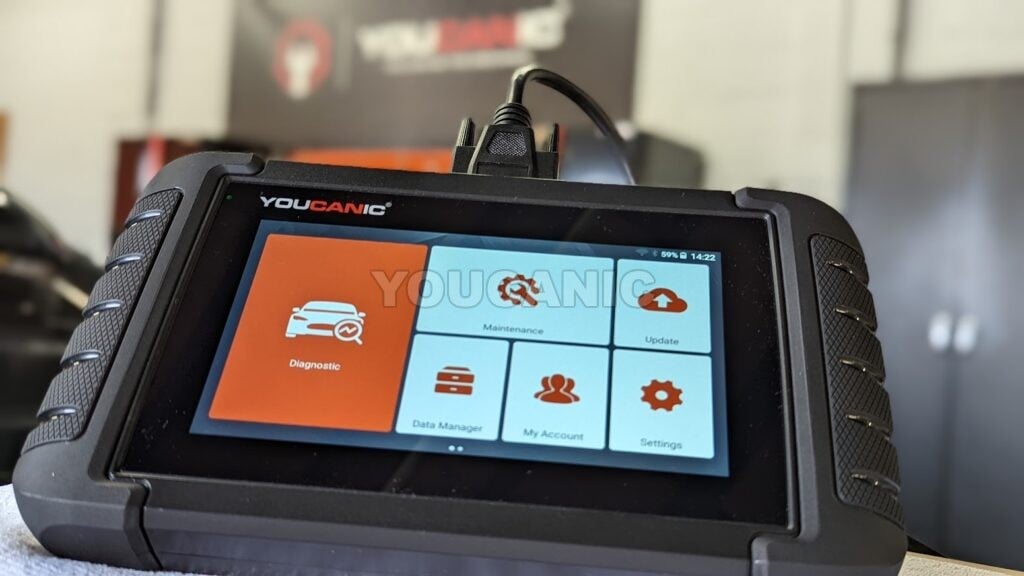
With a YOUCANIC UCAN-II Pro scanner, diagnosing faults in your Nissan can be easily performed without going to an expensive shop. This powerful scanner can read and clear fault codes from the main systems on supported models in your Nissan. It can also display live data, perform bidirectional tests, and more.
- Locate the OBD2 port under the dashboard.
- Turn the ignition to position II. All dash lights will turn on.
- Allow the scanner to power on.
- Select the Automatic Transmission menu or A/T menu.
- Select read codes.
- Verify that fault codes are pointing to a faulty transmission speed sensor.
Check the fluid before you change the sensor
On a Nissan CVT, symptoms that look like a speed sensor fault very often are not. Slipping, shuddering at low speed, hesitation when pulling away and the transmission dropping into a fail safe mode are all classic signs of degraded or low CVT fluid, and they overlap almost exactly with what a failing speed sensor produces.
Check the fluid condition and level using the correct procedure for your model, which on these transmissions means the fluid at a specified temperature rather than simply warm. Fluid that has gone dark or smells burnt has been overheated, and no sensor will fix that. Bear in mind too that these transmissions take a specific Nissan CVT fluid, NS-2 or NS-3 depending on the unit, and that ordinary automatic transmission fluid will destroy the belt and pulleys. Universal fluids claiming CVT compatibility are a false economy against the cost of the transmission.
If the car is still within the extended powertrain coverage Nissan applied to the CVT on a number of model years, have a dealer check your VIN before authorizing any work. That check costs nothing and the difference is substantial.
Read the code so you change the right sensor
There is more than one speed sensor on these transmissions. The input or primary sensor reads the speed going in, and the output or secondary sensor reads the speed coming out, and the control module compares the two to work out what the pulleys are doing. They are different parts in different locations, and the stored code names which circuit is at fault.
Guessing is expensive here because of the access. As the procedure notes, reaching these sensors is not a five minute job, so spending two minutes reading the code first is time well spent. A full system scanner that accesses the Nissan transmission module will show both speed values live while the car is driven, and a sensor reporting zero or jumping erratically while the other reads sensibly identifies the faulty one beyond doubt. A generic code reader cannot reach that module at all.
Keep the fluid clean while you are in there
Whichever route you take, dirt is the enemy. Clean the area around the sensor thoroughly before removing it, so nothing falls into the transmission when the sensor comes out. Fit a new O ring rather than reusing the old one, since a weeping sensor seal loses fluid slowly and quietly, and a CVT run low on fluid fails in a way that cannot be repaired.
Top up whatever fluid is lost during the job with the correct specification, check the level properly afterwards at the specified temperature, and clear the stored codes rather than waiting for them to clear themselves. A historic code left in memory will keep the warning light on and can keep the transmission in a reduced performance mode even after the repair is complete.
Which CVT Is in Your Nissan?
| CVT | Common US applications | Fluid |
|---|---|---|
| JF009E (RE0F08A) | Versa 2007 to 2012, Cube 2010 to 2014 | NS-2 |
| JF010E (RE0F09A/B) | Altima V6 2007 to 2012, Maxima 2009 to 2015, Murano 2008 to 2014, Quest 2011 to 2015 | NS-2 |
| JF011E (RE0F10A) | Altima 2.5 2007 to 2013, Sentra 2007 to 2012, Rogue 2008 to 2015 (incl. Rogue Select), Juke AWD | NS-2 |
| JF015E (RE0F11A) | Versa 2012 to 2018, Versa Note 2014 to 2018, Sentra 2013 to 2018 | NS-3 |
| JF016E (RE0F10D) | Altima 2.5 2013 to 2018, Rogue 2014 to 2019, Rogue Sport 2017 to 2019, Sentra Turbo | NS-3 |
| JF017E (RE0F10E) | Altima 3.5 2013 to 2018, Pathfinder 2013 to 2018, Murano 2015 to 2018, Maxima 2016 to 2018, Quest 2015 to 2017 | NS-3 |
Sources: Transend CVT application chart, Gears Magazine and the fluid part numbers in Nissan bulletins. Newer Altima, Sentra and Rogue models are not listed because we could not confirm their units. Confirm by VIN.
What Nissan’s Own Bulletins Say
- Corroded secondary sensor connector (2014 Rogue): bulletin NTB14-019 covers codes P2765, P0500, P1574, P1715 and P0720 caused by moisture at the secondary speed sensor connector. Fix: clean the connector and replace the sensor (31935-1XF00). No relearn is listed. NTB14-019.
- Same issue on new cars (2014 Altima, Pathfinder, Rogue): dealer campaign PC260 inspected the output speed sensor terminals and replaced corroded sensors, torquing the bolt to 5.9 Nm (52 in lb). PC260.
- P1715 is often NOT the sensor: when P1715 appears together with P0776, Nissan bulletins for the 2013 to 2014 Altima 2.5, 2014 to 2016 Rogue and 2017 to 2018 Sentra Turbo and Rogue Sport point to belt slip and the valve body, not the speed sensor. NTB15-086g, NTB18-077.
- P1778 on 2010 Maxima, Murano and V6 Altima: Nissan says do not replace either speed sensor, the TCM or the transaxle; replace the valve body. NTB11-002c.
In short: a clean speed sensor code on its own, especially with a corroded connector, is a good candidate for a sensor. A speed sensor code alongside ratio or pressure codes usually means the CVT itself has a problem.
Part Numbers and Prices
| Genuine Nissan part | Role and fitment | Dealer online price |
|---|---|---|
| 31935-1XF0C (replaces 31935-1XF00) | Secondary (output) sensor, many 2008 to 2018 Altima, Rogue, Sentra, Juke, Murano, Maxima, Pathfinder, Quest | $186.38 |
| 31935-1XF0D (replaces 31935-1XF01) | Primary (input) sensor, e.g. 2010 Altima 2.5, 2015 Versa | $105.78 to $107.60 |
| 31935-3AX0B | Revolution sensor, 2007 to 2012 Versa | $178.53 |
| 31935-X420A / X420C / X420D, 31935-3XX0A/B | Revolution sensors, 2016 Sentra | $140 to $186 |
Prices from Nissan dealer parts sites in October 2026. The primary and secondary sensors are different parts, and both connectors look identical, so label them before you unplug anything. Aftermarket copies sell for under $20, but we have no data on their reliability. Confirm the part by VIN.
Extended CVT Warranties: Check Before You Pay
- 2003 to 2010 CVT models: extended to 10 years or 120,000 miles in 2009 (most of these have now aged out).
- 2012 to 2017 Versa, 2014 to 2017 Versa Note, 2013 to 2017 Sentra, 2013 to 2016 Altima, 2013 to 2017 Juke: 84 months or 84,000 miles. Nissan bulletin.
- 2014 to 2018 Rogue, 2015 Rogue Select, 2015 to 2018 Pathfinder: 84 months or 84,000 miles. Nissan bulletin.
- 2017 to 2018 Altima, 2018 to 2019 Sentra, Versa and Versa Note: 84 months or 84,000 miles. Nissan bulletin.
These extensions cover the CVT assembly, internal parts, valve body and TCM reprogramming. External speed sensors are not listed by name, so ask the dealer to check your VIN. If the real fault is the valve body or belt, it may be covered.
Fluid Facts That Matter Here
- Use genuine Nissan CVT fluid: NS-2 for the 2007 to 2012 generation, NS-3 for 2013 and newer units. Nissan says damage from the wrong fluid is excluded from warranty, and red fluid in the CVT means someone used the wrong fluid. NTB12-057.
- Nissan checks the level at 70 to 80 °C fluid temperature with the engine idling, read on a scan tool. Overfilling can cause fail safe symptoms too.
- On a 2019 Altima or Rogue, Nissan says inspect the CVT fluid every 10,000 miles and replace it every 60,000 miles under severe driving. Nissan schedule.
When to Stop and Hand It Over
- The speed sensor code comes with P0776, P17F0, P17F1 or other ratio and pressure codes.
- The fluid is dark, burnt smelling or the wrong color.
- The car is inside an extended CVT warranty: let the dealer diagnose it for free.
- The codes return immediately with a new sensor, a clean connector and correct fluid level.
Telling a $100 Sensor From a CVT Problem
The scanner reads Nissan transmission codes and live speed sensor data. At idle in Park, the input sensor should read close to engine rpm and the primary sensor near zero on many units; one reading zero or jumping while driving points to that sensor. A generic OBD2 reader often cannot see the transmission module.
Work Safely
- Let the transmission cool before you start; CVT fluid and the case get hot enough to burn.
- Support the car on jack stands on level ground if you work from underneath.
- Catch any fluid that drips when the sensor comes out, and top up with the correct Nissan CVT fluid afterward; the wrong fluid can damage a CVT.
Check the cheap things first, then decide about a tool
The page already makes the point that matters most on this job: check the fluid before you change the sensor. On a CVT, fluid condition and level produce symptoms that imitate a speed sensor fault closely, and that check costs nothing. Do it first, every time, and a share of readers will stop there.
The tool question only arrives at the step above about reading the code so you change the right sensor. These transmissions carry more than one speed sensor and guessing between them is an expensive way to learn. If you need that reading once, rent one for seven days instead of buying the UCAN-II Pro for a single repair.
Frequently Asked Questions
Can a bad speed sensor make a Nissan CVT go into limp mode?
Yes. If the transmission computer loses an input or output speed signal, it often limits power and gear ratio to protect the CVT, which feels like limp mode.
Do I need to reset anything after replacing the sensor?
Clear the codes and test drive. Some Nissan CVTs benefit from having the transmission adaptive values checked afterward with a scanner that supports Nissan.
Is it the sensor or the CVT itself?
A speed sensor code with normal driving between faults points to the sensor or wiring. Shudder, whining and slipping without a sensor code point to the CVT itself.
Related guides: Lookup Nissan Transmission by Model, Year


Obd2 scanner not working in my nissan sunny 2002 model 1.3
Was this video taken underneath the car I cannot seem to find the sensor
very good very helpful thank you much
Always helpful. Thanks
very helpful thank you.
Excellent Inf….Clear Easy…Congra…