
Audi Safety System Malfunction – Meaning, Causes & Easy Fixes
You are driving home from a long day at work, or you have just started your car for a quick run to the grocery store, and suddenly, there’s a chime, and a warning appears on your dashboard: “Safety System Malfunction.” Are you uncertain about what it means and now are worried about continuing to drive your car afterward? This article will explore what the Audi Safety System Malfunction means, the systems and components it involves, and some tips to address it.
What does this Malfunction Mean?
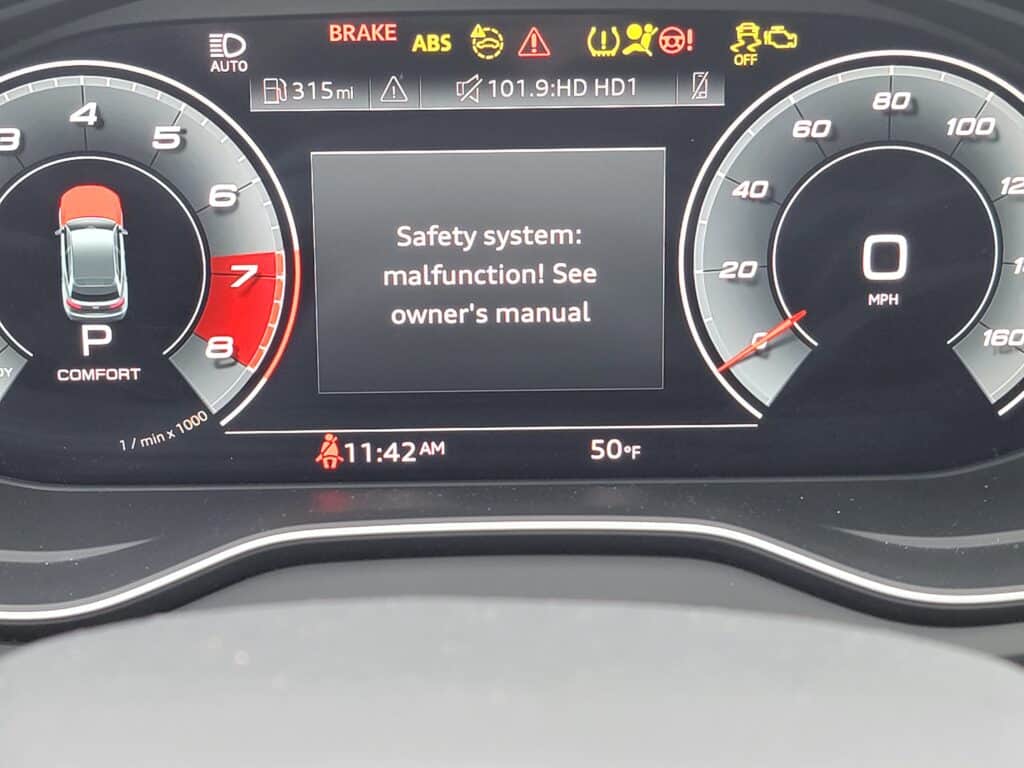
The Audi Safety System Malfunction warning message on your dashboard indicates a potential issue within the car’s safety components, which means the airbag may not deploy in case of an accident. Safety components in your Audi include airbags, seatbelts, seatbelt pre-tensioners, electronic stability control(ESC), anti-lock braking systems(ABS), and Audi pre-sense systems. In the event of a problem, you will see a warning message “Safety System Malfunction: See owner’s manual” on your dashboard, telling you something is wrong with your safety system.
The warning message is often accompanied by an airbag indicator light(a figure of a person sitting with seatbelts on and a solid circle facing him) on the dashboard. This typically happens because this error warning includes problems with your safety systems, including the airbags, control modules, sensors, wirings, and belt tensioners, telling you when something is wrong with these components.

🔧 Stop paying the dealer for every warning light
Get dealer level diagnostics at home with the YOUCANIC Full System Scanner.
- ✔ Works with all makes and models, including most luxury brands
- ✔ Topology map view shows all vehicle modules on one screen for faster diagnostics
- ✔ Bi directional controls to test fans, pumps, actuators and more so you do not have to guess
- ✔ Special resets and calibrations such as ABS bleed, EPB service, battery registration and more
- ✔ Free lifetime updates with no recurring fees

There will also be times when the warning will show, but no airbag indicator sign will be present. Some users have reported a faulty active lane assist light that came on before the safety-system-malfunction warning message showed up on their dashboard or their Audi pre-sense system warning sign lighting on(a yellow sign having a car enclosed in a dashed circle) because of a busted camera or unresponsive sensors. These can all be linked to the malfunction of the safety system as the cameras and sensors of these systems also help trigger seat belt tensioning operations in an emergency.
Symptoms
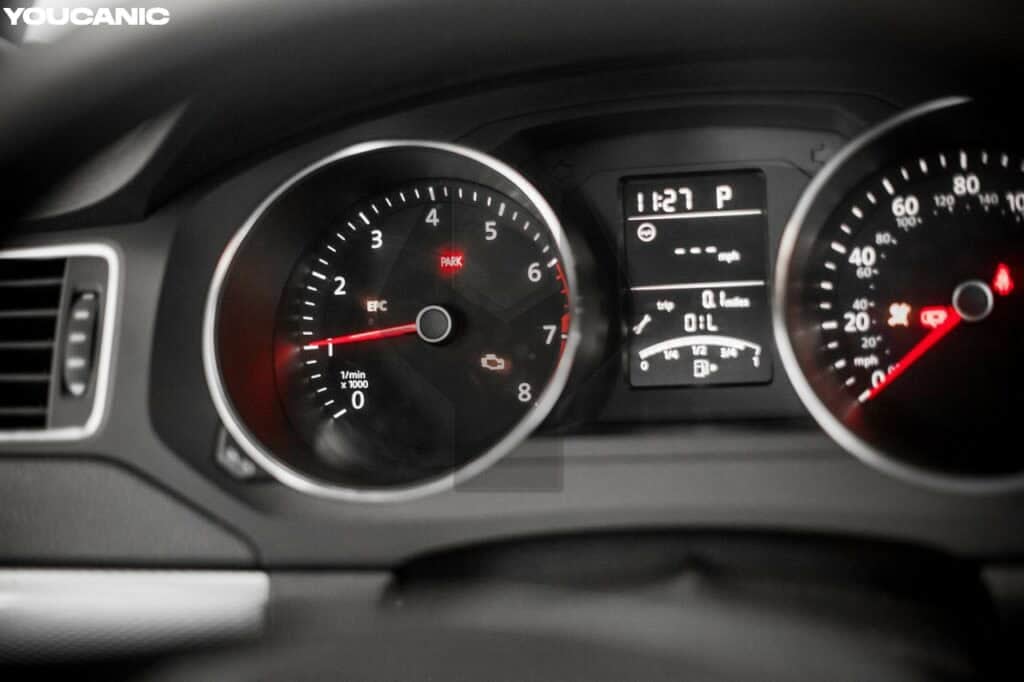
There is typically no way of knowing there is a problem with your Audi other than the warning message or airbag warning light, but these warning lights could indicate many other problems with the car. For example, when the warning message or airbag indicator light is visible on the dashboard, and you notice the stabilization or traction is off, the Electronic Stability Control (ESC) system has something to do with the safety system warning.
In normal conditions, the airbag indicator light turns on when you switch the ignition on and turns off after a few seconds. Your safety system may be malfunctioning if:
- The indicator light does not turn on when the ignition is switched on.
- It turns on and does not turn off after a few seconds.
- Flashes while driving.
It is always best to be careful when driving under these conditions until the issue is fixed.
Common Causes
- Safety malfunctions can occur because of any number of other factors. These include electrical issues, road-related damage such as driving through a deep pothole or bumps that may have triggered sensors causing technical issues, and software glitches your dealership can handle.
- There are also non-electronic that can greatly affect the functions of the system that should also be considered, such as worn-out brake pads that will need to be replaced and the build-up of dirt and water on your wheel speed sensors, which will make your ESC or ABS light turn on. These factors affect the braking pressure, which is also synchronized with how your belts should be tightened on Audi’s pre-sense system and how your airbags will deploy in emergencies.
Troubleshooting Tips
Some of the causes of your Safety System Warning sign can be diagnosed by the following steps you can try at home. But, if your car is still under the warranty period, we suggest you bring it to your dealer and let them take care of it.
For those whose warranty has expired, here are simple steps you can take to troubleshoot what’s causing your safety system malfunction.
Check what is obvious first. This is a valuable tip that has saved countless people’s hard-earned cash. Look out for those faults that can be directly seen or felt. For this case, you can check for the following:
- Check out the battery terminals for loose connections and corroded lugs.
- Make a note of when you last replaced your battery. A good battery lasts at least 2 to 3 years. Beyond this, we recommend regularly monitoring your battery’s performance and replacing the battery when performance begins failing. You do not want to replace your battery on the side of the road.
- For ESC or ABS faults, look at the wheel speed sensors. If covered in mud, dirt, or thick oil, they must be cleaned.
- Check all visible sensors around your engine bay for loose sockets and connection points, and snap them back in.
- Check the wiring harnesses and any wires for peeling or chewed insulation.
- Check each of your seatbelts for any signs of damage.
2. If visual checks turn up nothing, check with diagnostic tools.
- Test the battery – An automotive battery’s function is to provide electrical power to the engine to start and supply the demands that exceed the alternator’s output. A weak battery causes some automotive faults, so it is best to get it tested.
- Check the Fuses – Fuses provide overcurrent protection in an electrical circuit. A strong current can harm components, electrical wirings and electronic systems connected to the circuit. In this case, the fuse breaks itself before the current runs through them. They are located collectively inside fuse boxes that are seen in the engine bay close to the battery and the car’s Electronic Control Unit (ECU), and inside the cabin close to the driver’s seat. One blown fuse can result in problematic issues in your car, so you must know how to check faulty fuses. Look for the fuse specific to airbags, seat belts, and other safety systems. Look at the inner side of the cover of the fuse boxes; there is usually information about the fuse printed on it. To test fuses, you can use test lights or multimeters. You may also verify if the fuse is blown by checking a melted or disconnected conductor at the center of the fuse.

- Using an OBD-II scanner: For those unaware of this modern troubleshooting tool, OBD-II (On-board diagnostics) is a portable electronic device that connects to your vehicle’s computer system to extract diagnostic codes. The OBD-II scanner tells you on the spot what might be causing your warning indicators to light in your dashboard. Plug in your OBD-II scanner and run your diagnostic procedures. You can start troubleshooting from those fault codes that appear in your scanner.
Common Fault Codes
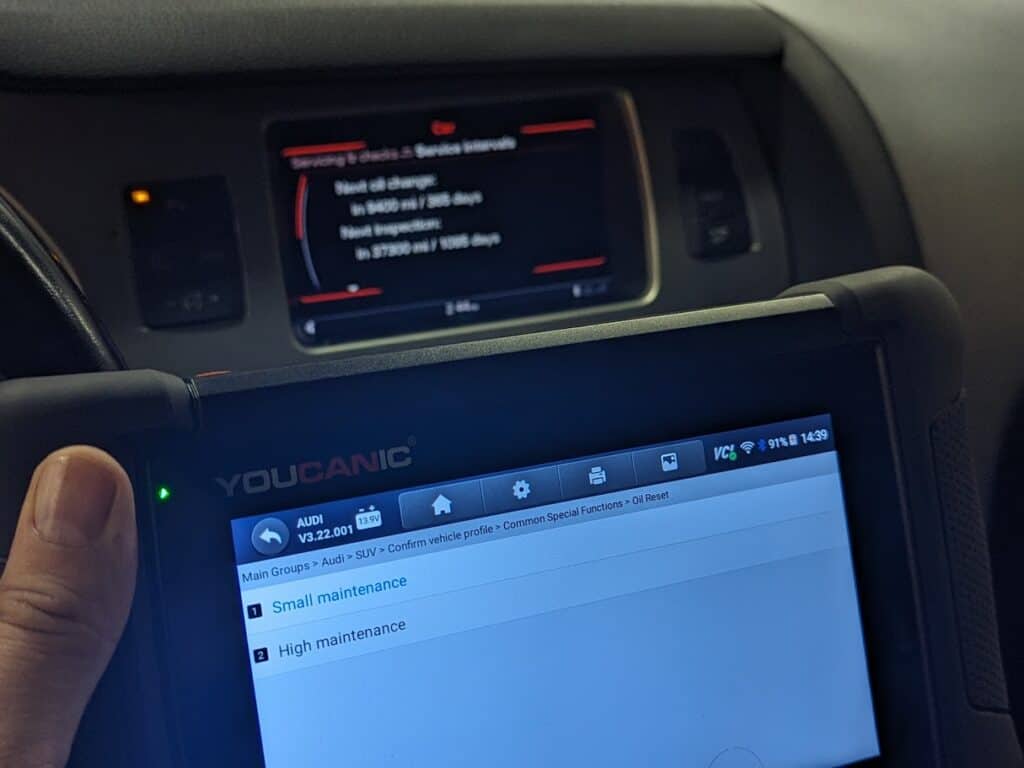
You can simply delete the fault codes in your OBD-II device straight on. If that does not work, try resetting your battery by unplugging your battery’s negative terminal from the battery for at least 30 minutes. The error might be a system glitch if the code does not return after the reset.
| Fault Code | Fault Description |
| 4660 | Fault codes on ABS Module |
| 24613 | Implausible data received from Airbag Control Module |
| 23410 | Implausible data received from the ABS Control Module |
| 12669184 | No communication with Airbag control module |
| 4530176-78-80 | Multi-Axis Accelerometer in Airbag Control Module |
| 9438747 | Igniter for Seat Belt Tensioner; Driver’s Side |
| 9439003 | Igniter for Seat Belt Tensioner; Passenger’s Side |
| 9572123 | Ignitor for Passenger Airbag Release Valve – Resistance too high |
| 9572122 | Ignitor for Passenger Airbag Release Valve – Resistance too low |
| 9571866 | Ignitor for Drivers Airbag Release Valve – Resistance too low |
| 9571867 | Ignitor for Drivers Airbag Release Valve – Resistance too high |
| 9442075 | Driver’s Belt Force Limiter Igniter – Resistance too high |
| 9442074 | Driver’s Belt Force Limiter Igniter – Resistance too low |
| 9442331 | Passenger’s Belt Force Limiter Igniter |
| 9437201 | Igniter for Driver’s airbag – short to ground |
| 9439771 | Front Passenger’s Side Airbag Igniter |
| 9440027 | Driver’s Side; Side-airbag Igniter |
| 9445937 | Seat Occupied Recognition Control Module |
| 9444373 | Safety Belt Switch – Driver Side |
| 9444629 | Safety Belt Switch – Passenger Side |
| 9444885 | Driver’s Seat Position Sensor |
| 9445141 | Passenger’s seat position sensor |
Sometimes, the fault codes come back even though numerous deletes and battery resets were performed. This signals that an active fault is present in the system and must be fixed. If you’ve tried all of our troubleshooting steps above, your next step is to bring the car to a trusted dealer or repair shop. Often, the problem is as simple as a software update. Some users also reported that the dealer replaced the sensors of their airbags, seatbelts, and even sensors of their pre-sense system.
Prevention tips
Because of the many sensors associated with the Safety System of Audi, it’s only normal to identify these components as one culprit to the problem. It is only best to monitor and conduct regular inspections of these sensors, ensuring they are always intact and clean, free from dirt, mud, and water.
When working on something in your car, especially when the activity requires some sensors to be detached, always remove the negative terminal of your battery. This way, deactivated sensors will not be marked as an error in your car’s ECU. Disconnecting the battery also reduces the risk of electrocution when working with wires.
Conclusion
All the Safety Systems of your Audi work together to protect its passengers by detecting hazards, preventing collisions, and minimizing injuries during accidents. Ignoring the malfunction of even just one component of the safety system would greatly affect the operations of the other systems as they are intended. The seat belt that should automatically be tensioned in emergencies, for example, did not work because of a busted fuse that gets in the way of triggering the seat belt’s advanced mechanism because the owner ignored the warning indicator sign in the first place. This compromises the effectiveness of the safety systems during emergencies and the vehicle’s reliability through the advanced technologies designed to keep the occupants safe.
It’s not that hard to diagnose vehicle errors nowadays. Modern vehicle management systems now perform self-diagnostic checks on the sensors and actuators connected to the ECU. If there are faults in any of the vehicle’s components or the component’s associated circuits, a code is stored in the ECU memory. A scanner like the YOUCANIC scanner is required to retrieve these codes. This tool is very useful if you own a modern car.