Which OBD2 Scanner Should I Buy? A Simple Guide
Reviewed/Verified by:

An OBD-II scanner allows you to read and clear Diagnostic Trouble Codes (also known as fault codes, DTCs) on vehicles 1996 and newer. Your dealer and mechanic use OBD-II scanners to diagnose most problems with today’s vehicles. While the scanners used at the dealership are the most advanced and expensive, aftermarket scanners are readily available for DIYers who want to troubleshoot their vehicles.
At a Glance
- The old rule has changed. Reading ABS, airbag and transmission codes used to be a premium feature. A $49 phone dongle does it now. The line that still costs money is commanding the car and OEM depth, not reading it.
- Read ($16 to $30): engine codes only. Fine for a check engine light and nothing else.
- Read everything ($49 to $160): every module, live data. Command ($250 and up): bidirectional tests, some coding. OEM depth ($600 and up): brand specific service procedures and calibrations.
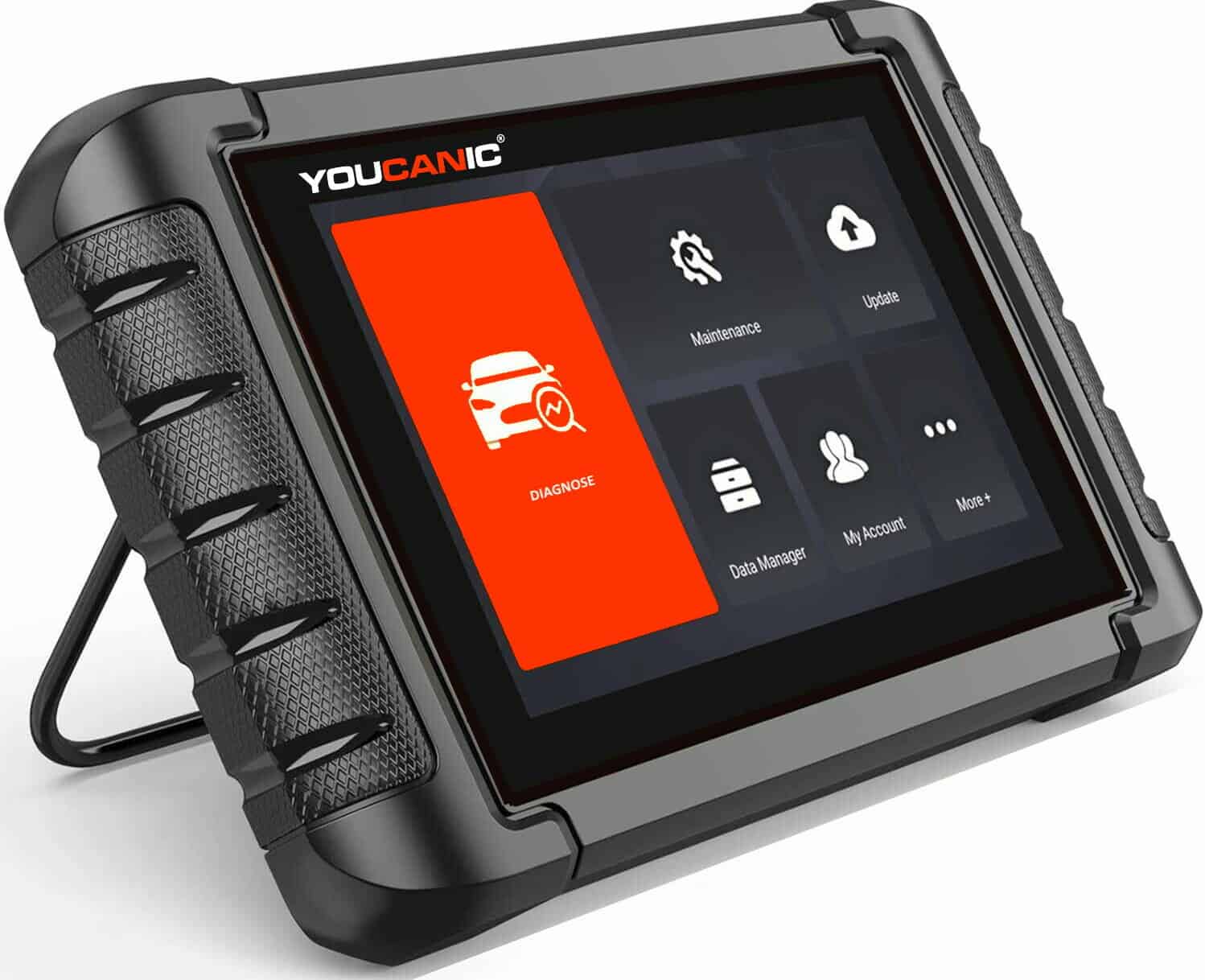
- Our pick: YOUCANIC UCAN-II Pro (our own scanner) for owners who work on several makes on supported models.
- Before buying: confirm coverage for your exact make, model and year
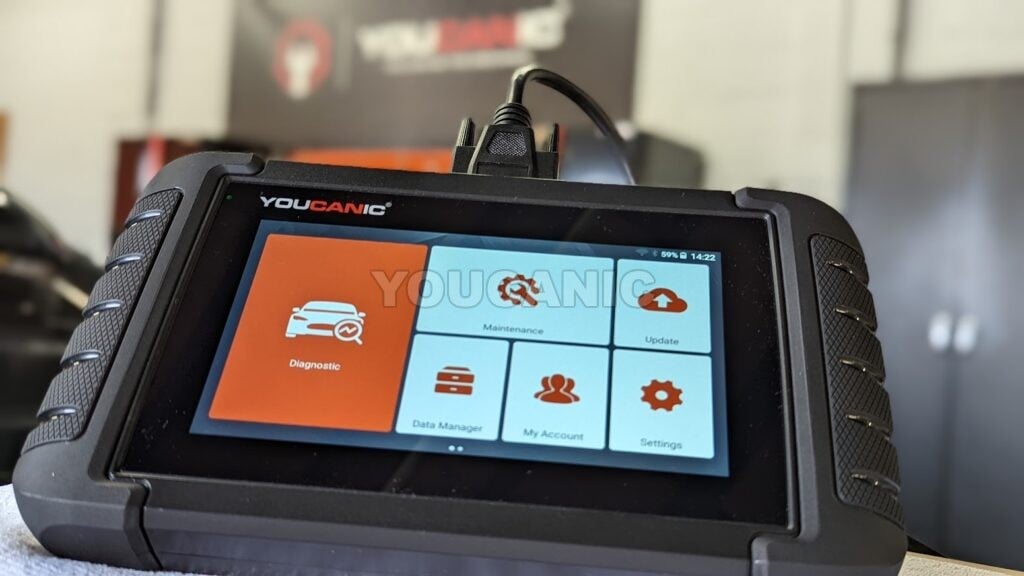
Tips for buying a good OBD-II scanner:
When choosing an OBD-II diagnostic scanner, it’s important to consider the following factors:
- Compatibility: Make sure the scanner is compatible with your specific make and model of vehicle. Some scanners are only compatible with certain years and models of vehicles, so check the manufacturer’s specifications before purchasing.
- Features: Consider the features you need in a scanner. Some basic scanners only read and clear codes, while more advanced scanners can display live data, freeze frame data, and even perform bi-directional controls.
- Ease of Use: Look for a scanner that is easy to use, with a clear and intuitive interface. Many scanners have a user manual or online tutorials to help you get started.
- Brand: Choose a reputable brand with a good record of producing reliable scanners. Read customer reviews to get an idea of the quality and performance of different scanners.
- Price: Compare prices between different scanners, but don’t compromise on quality for a lower price. Some scanners are more expensive but will offer more features and better quality.
- Support: Consider the scanner’s warranty and customer support. Ensure you can easily contact the manufacturer if you have any problems with it.
By considering these factors and doing some research, you can choose a good OBD-II scanner that will meet your needs and help you diagnose and troubleshoot problems with your vehicle.

🔧 Find out what is actually wrong before you pay someone to guess
Dealer level diagnostics at home with the YOUCANIC UCAN-II Pro.
- ✔ Covers most makes and models, including many luxury brands. Send us your VIN and we will confirm your car before you order
- ✔ Reads every module, not just the engine, so you find the faults a basic reader says are not there
- ✔ Commands the car: test a fan or pump, bleed ABS, retract an electronic parking brake, register a battery
- ✔ No subscriptions. Free lifetime updates, so the price you pay is the whole price
- ✔ Backed by real mechanics in the USA you can email before and after you buy
Featured in The Wall Street Journal
Entry-level OBD-II (OBD-2) scanners start at about $20 but can only diagnose the check engine light. The professional scanners can go over $1000 and read, clear, and program any module in any car.
We divide scanners into three categories to help you choose the best OBD-2 scanner.
- Level 1: Basic Code Readers, the Least Expensive, Can only read and clear codes from the Engine Control Unit (ECU).
- Level 2Multi-system OBD-2 Scanner, which Can read and clear codes from the Engine, Transmission, ABS, and Airbag. Depending on the scanner, it may also be able to read and clear codes from other modules such as climate control, suspension, charging system, etc.
- Level 3: Professional OBD-2 Scanners, Professional Level: These scanners offer functionality similar to that of the dealer. They can read, clear, program, view live data, and activate all systems in your car.
Regarding OBD-2 scanners, there is no one-size-fits-all solution. A key component is how much you are trying to spend on a scanner and whether you want it to work on only one make or many vehicle models.
When buying an OBD-2 scanner, ask yourself these questions:
- What are you trying to diagnose?
- Check Engine Light,
- ABS Problems
- Airbag / SRS Light
- Transmission Problems
- Program Modules
- What is your budget?
- Do you need a scanner to work on one make (for example, BMW) or multiple makes?
Our Pick: YOUCANIC UCAN-II Pro (Our Own Scanner)
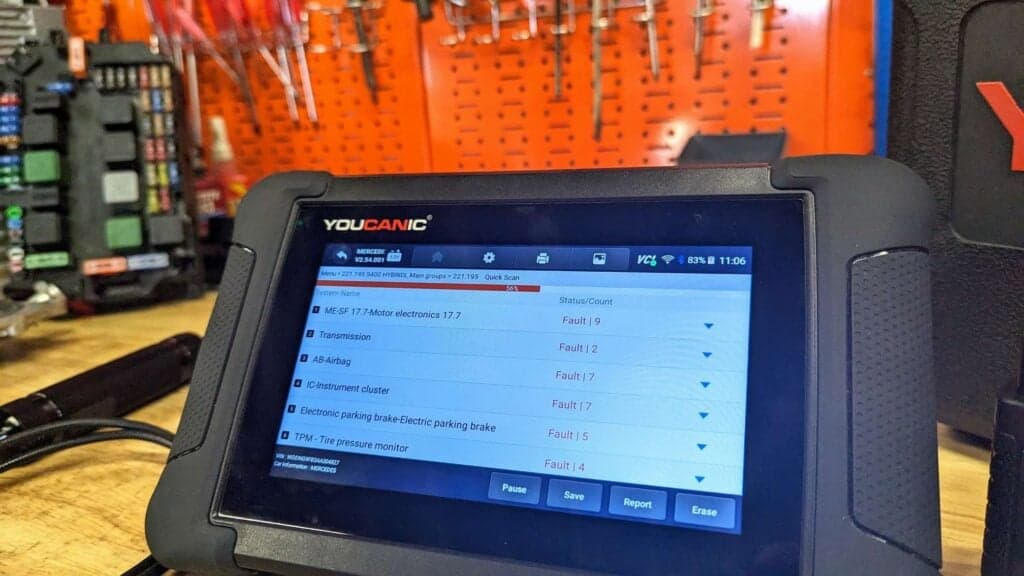
Here are some cons of other OBD-II scanners compared to the YOUCANIC Full System Scanner
- Many scanner manufacturers make scanners that require a yearly subscription.
- It can diagnose one make but doesn’t work on all car makes. You will have to pay more to cover other vehicle makes.
- I can’t diagnose all vehicle systems. May only diagnose the engine, airbag, transmission, and ABS problems. That’s only four systems. Modern cars can have up to 40+ systems.
- Don’t support bi-directional support for sensor testing and activation.
If you want a scanner that can do all these, you must spend thousands of dollars and most likely pay a yearly subscription.
So we decided to launch the YOUCANIC full system scanner that works on all makes and models.

The YOUCANIC full system scanner:
- Works on all makes.
- Can read and clear codes from all vehicle control units.
- View live data from any sensor.
- Bi-direction support to activate and test sensors and motors.
- Reset functions depending on the model.
If that is not enough, remember that the YOUCANIC scanner does not require a yearly subscription like other professional-level scanners. We believe that the YOUCANIC scanner offers the best OBD2 for the money for auto mechanics and DIYers.
We have many how-to videos showing you how to troubleshoot car problems. Once you get the codes, the YOUCANIC technicians can help.
Full disclosure: this is the scanner we make, so read the section below where we say plainly what a cheaper tool will and will not do. We built the YOUCANIC UCAN-II Pro because the tools in our own garage either charged a yearly subscription or covered one or two makes. It has no subscription and never will, it covers more than 140 makes, and it performs the service procedures that matter on European cars on supported models. If you work on several brands and want to stop paying for software every year, that is the case for it.
What $749 buys that $250 does not
We should be straight with you, since we sell one of these. A $249 Foxwell NT710 is bidirectional and will code some modules. If all you need is to read every system and command a few components, that tool does it. Anyone telling you that you must spend $749 to read an ABS code is selling you something.
Here is the honest difference. First, no subscription, ever. That is not a small line item on the tools you are comparing against:
| Tool | Annual software renewal |
|---|---|
| Autel Ultra S2 | $1,695 |
| Autel MS919 S2 | $1,495 |
| Autel MS909 S2 | $1,295 |
| Autel MS906 Pro | $595 |
| Autel MS906 | $495 |
| Snap-on | Billed weekly, price not published |
| Launch X431 professional line | Paid renewal |
| YOUCANIC UCAN-II Pro | $0 |
Three years of renewals on a mid range Autel comes to around $1,785 in software alone, which is more than our scanner costs outright, before you have bought the Autel. To be fair about it: letting a subscription lapse does not brick those tools. They keep the software they already have and stop receiving new vehicle coverage and online services. It is a running cost, not a hostage situation.
Second, the service procedures, not the module list. Reading ABS and airbag codes is table stakes now. The jobs that still separate tools are things like deactivating a Mercedes SBC brake system before you touch the pads, resetting the SBC counter afterwards, battery registration, electronic parking brake service mode, steering angle calibration and brand specific adaptations. Those are the functions worth paying for, and they are the ones we build for on supported models.
Third, the guides behind it. We publish over two thousand repair articles on this site. The scanner tells you the code; the library tells you what that code means on your car, what usually causes it, and whether you can drive it. No other scanner company has that, and it is the part we would least like to compete against.
Level 1: Basic OBD-II Code Readers
You can retrieve Diagnostic Trouble Codes (DTC) (also called fault codes) that trigger the Check Engine Light and Service Engine Soon. Level 1 scanners don’t access other modules besides the Engine Control Unit (ECU) or provide any coding capabilities.
Simply plug into the OBD-2 port and read the code. They show you a fault code. A few scanners even tell you what the code means. Regardless of what description you get from the scanner, write down the code and do online research to understand the common problems with your make.
Capabilities
Here is a list of what you can do with these scanners:
- Read Fault Codes from the Engine Control Unit
- Determine why the Check Engine Light is on.
- Erase Check Engine Codes
- View Freeze Frame Data
- Display live sensor data from ECU
Limitations
- It cannot access other modules.
- Cannot read codes from ABS, SRS, transmission, etc.
- Cannot troubleshoot TPMS
- No programming or coding
Most Level 1 scanner sells for under $100. Typically, we can only diagnose the Check Engine Light or Service Engine light.
Many of these scanners can display live sensor data that the Engine Control Unit controls. Level 1 OBD-2 scanners cost as little as $15. Every car owner must, at a minimum, have one of these cheap OBD-2 scanners in the glove box.
Popular Level 1 Code Readers
| Tool | Type | Price | What you get |
|---|---|---|---|
| Veepeak OBDCheck VP11 | Phone dongle | $15.99 | Android only. The genuine price floor. |
| Veepeak OBDCheck VP01 | Phone dongle | $19.99 | iOS and Android over WiFi |
| ANCEL AD310 | Handheld | about $20 to $26 | Engine codes, no battery or app needed |
| TOPDON ArtiLink400 | Handheld | $29.99 | Engine and emissions readiness |
Level 2: Multi System OBD2 Scanners

Level 2 scanners (also called multi-system OBD2 scanners) are slightly more expensive, but their main advantage is that they allow you to read and clear fault codes from many modules.
If you work on cars frequently or are trying to troubleshoot problems other than the check engine light, you need multiple system OBD-2 scanners. These scanners can reset the check engine light and read and clear codes from various modules, including Anti-Lock Brakes, Airbag systems, Transmission, Tire Pressure Monitoring systems, etc.
Several multi-system scanners only read clear codes from the engine, transmission, ABS, and airbag modules, while a full-system OBD-2 scanner can read, clear, and reset fault codes from almost all modules on the vehicle. A full-system OBD-2 scanner is a way to go if you work on cars frequently. One trip to the dealer could save you enough money to buy one of these scanners.
Even if you haven’t used a whole system OBD-2 scanner before, don’t worry. They are very easy to use and function like basic OBD-2 code readers. The main difference is that they can access another system in your car, not just the ECU.
This tier has largely collapsed into the one below it. A $49 TOPDON TopScan, a dongle driven by a phone app, reads every system on the car with no subscription on that function. A Launch CRP123X handheld runs roughly $130 to $160 and covers engine, transmission, ABS and SRS across 33 makes. A TOPDON ArtiDiag500 is $149.98. If reading non engine modules is all you want, you no longer need to spend much.
Capabilities
- Read/Erase Check Engine Codes
- Read/Erase ABS Fault Codes
- Read/Erase Airbag / SRS Codes
- Troubleshoot transmission problems
- View Sensor Live Data
Limitations
- No Coding
- No Programming
- One-directional communication
Level 3: Professional Diagnostic Scanners
Professional diagnostic scanners provide similar functionality to those used at car dealerships. They are meant for mechanics who operate auto repair shops.
Bidirectional capability no longer starts at $1,000. A Foxwell NT710 is bidirectional at $249 and a TOPDON ArtiDiag Pro at $419. What you buy above that is depth rather than the feature itself: shop grade tools run roughly $640 to $2,200 (TOPDON Phoenix Lite 2 at $639, Phoenix Smart at $2,199), and tool truck brands start higher still, with the Snap-on SOLUS+ at $3,599 MSRP and that is their entry handheld, not their flagship.
A complete system expert scanner is not limited to one make but works on most car brands, including Honda, Toyota, BMW, VW, Mercedes, Porsche, Ford, Chevrolet, etc. Bi-directional supports allow you to activate, program, and test sensors and systems in your car. These are professional scanners and are more expensive. These professional OBD-2 scanners are often used by auto mechanics and offer full system diagnostics.
We have included a few that are easy to use by mechanics and car owners who can afford one. Level 3 OBD-2 scanners offer a bidirectional function, which means you can activate and test various car sensors. Many car manufacturers require that the dealer can only code certain modules. Professional scanners cannot code the replacement of certain modules if the dealer can only complete the coding.
Popular Level 3 Scanners
- YOUCANIC UCAN-II Pro, $749, no subscription
- Foxwell NT710, about $249, bidirectional with some coding
- TOPDON Phoenix Lite 2, $639, or Phoenix Smart, $2,199
- Autel MaxiSYS range, with annual software renewals from $495
- Snap-on SOLUS+, $3,599 MSRP, subscription billed weekly
Frequently Asked Questions
What is the difference between a code reader and a scanner?
A code reader only reads and clears engine codes. A scanner can also read other modules such as ABS, airbag and transmission, show live data and perform resets.
Do I need a scanner that reads ABS and airbag codes?
If you want to fix warning lights other than the check engine light, yes. But this no longer costs much. The cheapest handhelds are still engine only, while a $49 dongle now reads every system. The real question in 2026 is whether you need to command the car, run a bleed procedure, reset a service counter or calibrate a sensor, because that is where tools still differ.
Will one scanner work on all my cars?
Generic engine codes work on every 1996 and newer car sold in the US, but full system coverage varies by brand. Check the scanner’s coverage list for each vehicle.
Check these troubleshooting and repair guides for more help on your vehicle.