
BMW Instrument Cluster Not Working
Reviewed/Verified by:

If you are experiencing an issue with your BMW instrument cluster not working, it could be caused by various factors. Some common causes of this problem include a faulty instrument cluster, a problem with the vehicle’s battery or electrical system, a malfunctioning alternator, or a problem with the vehicle’s Engine Control Module (ECM).
At a Glance
- Most common cause: the instrument cluster (kombi) module itself. These suffer from failed solder joints, display pixel loss and stepper motor failure as they age.
- Check first: the cluster fuse and the battery. A dead cluster with other electrical oddities is usually a supply problem, not a module problem.
- Classic symptoms: a blank or flickering display, gauges that stick or drop to zero, backlight failure in sections, and the cluster going dark intermittently over bumps.
- Critical: the cluster is VIN and mileage locked. A used unit from another car will show that car’s mileage and usually will not accept your keys.
- Cost: $200 to $500 to repair your original. $900 to $2,000 for a new unit coded by the dealer.
One of the first steps in troubleshooting this issue would be to check the vehicle’s battery and electrical system to ensure proper voltage and amperage are supplied to the instrument cluster. If the battery and electrical system are functioning properly, the next step would be to check for any DTC (Diagnostic Trouble Codes) stored in the vehicle’s ECM. These codes can often provide insight into the cause of the problem and guide the diagnostic process.
Another possible cause of an inoperative instrument cluster in a BMW can be a failure in the vehicle’s communication bus, which connects the cluster and other modules in the car. This could be due to a faulty cluster, a problem with the wiring, or a malfunction in one of the other modules on the communication bus.

🔧 Find out what is actually wrong before you pay someone to guess
Dealer level diagnostics at home with the YOUCANIC UCAN-II Pro.
- ✔ Covers most makes and models, including many luxury brands. Send us your VIN and we will confirm your car before you order
- ✔ Reads every module, not just the engine, so you find the faults a basic reader says are not there
- ✔ Commands the car: test a fan or pump, bleed ABS, retract an electronic parking brake, register a battery
- ✔ No subscriptions. Free lifetime updates, so the price you pay is the whole price
- ✔ Backed by real mechanics in the USA you can email before and after you buy
Featured in The Wall Street Journal

BMW instrument clusters have several issues ranging from dead pixels problems to gauge not working or the instrument cluster display losing power. These problems can occur after jump-starting a dead battery, resulting from extreme weather conditions or an older vehicle.
What is the BMW KOMBI module?
The BMW KOMBI control unit is the module that controls the instrument cluster. Most of these problems are caused by the KOMBI module. This guide will teach you about the KOMBI module, common BMW instrument cluster problems, and how to read and clear codes from the KOMBI module.
The instrument cluster may need to be replaced in some cases. This is often the case if the cluster is physically damaged or failed due to a manufacturing defect. A certified BMW mechanic can diagnose and repair the issue after a proper inspection and testing.
Symptoms
Things that you may notice if your BMW instrument cluster fails.
- Information display failure cluster power loss.
- The instrument cluster is not working after a jump start.
- Speedometer, rev counter, trip computer, fuel or temp gauge are not working
- None of the gauges work or light up.
- No interior sound (beep), radio/clock, or backup camera.
- Fuel and temp gauges give out false readings.
- Turn signals do not flash on a cluster.
- High beam not displayed in the cluster
- The odometer is hard to read.
- Intermittent or non-working gauges
- Fuel, temperature, MPG, speedometer, and tachometer needles stuck.
- Lights are faded, dim, or not working.
- Missing display pixels and can’t read data
- Problems communicating with the unit
- The diagnostic scanner will not talk to the KOMBI module.
- The cluster loses power intermittently.
Common Problems
In this section, we will look at common BMW cluster problems. BMW cluster issues can range from complete or partial loss of LCD, fading Information display, back Light burning out, and even gauge (stepper motor) failures.
Dead Pixel Problem

BMW pixel problem is a common issue on many 2001 to 2006 BMW E53 X5, 1996 to 2003 E39 5-Series, 1995 to 2001 E38 7-Series. Instead of replacing the cluster, which can be expensive, use a repair service to change the LCD and the ribbon cable on your existing cluster.
A BMW repair service is much cheaper than replacing the cluster. You will have to remove your cluster and send it in for repair. The mileage and other settings on your cluster remain the same; no need to program your cluster. Check out these BMW Instrument Cluster Repair Services listings.
Stuck Gauges
When the fuel, temperature, MPG, speedometer, and tachometer needles get stuck or barely move, the problem can be the stepper motors that move the needle.
To fix this problem, you must replace your BMW cluster or repair your existing one. Check out these listings on BMW Stepper Motor Repair Service. You will have to remove and ship your existing BMW cluster to get it repaired.
Dim cluster issue
You may notice that it is difficult to see the lights on your BMW cluster during the day. Increasing the dimmer button’s cluster light intensity does not fix the problem. First, check that the dimmer switch is not the problem.
The dimmer switch itself can fail. Another common problem is the backlight cluster bulbs burning out. Some models, such as the M2, have visibility issues. Part of the problem is that the M2 has low-contrast silver letters.
Manually switching on the lights or programming the dashboard lights always helps slightly but does not solve it.
Dead cluster after a jump start
Many BMW owners report that the instrument cluster stops working after the car is jump-started. Functions such as fuel gauge, tachometer, digital display, odometer, and speedometer stop working.
This problem can sometimes be fixed by resetting the instrument cluster for at least ten minutes. You can reset your BMW cluster either by removing the cluster fuses, using a diagnostic scanner, or unplugging the cluster itself for a few minutes.
Note that there can be up to three fuses related to the IC. Note that a bad capacitor can also cause this problem on the PCB. Follow these instructions to jump-start BMW properly.
Electrolytic capacitor

On BMW ten years or older, capacitors inside the instrument cluster can fail. Replacing the failed capacitor will bring your BMW instrument cluster back to life.
Bad Printed Circuit Board (PCD)
Solder joints on the PCD can crack, causing intermittent issues where one or more instrument cluster functions, such as the odometer, stop working.
The instrument cluster can be removed, and the joints, including the connector pins, should be inspected and resoldered if they have any cracks.
Light Control Module
LCM and instrument cluster share data such as mileage data, VIN, etc. LCM is located in the front passenger footwell. It can get wet, causing issues and instrument cluster malfunctions.
Other problems
Blown a fuse, defective instrument cluster, issue with the voltage regulator, gauge motor, wiring, instrument cluster circuit board, blown LED lights,
How to Reset BMW Instrument Cluster
Resetting the cluster will often fix a BMW instrument cluster problem.
- Remove the fuse for the instrument cluster. There may be more than one fuse that you need to disconnect. Typically fuse 43 is the one that needs to be removed but check your fuse chart. Keep the fuse removed overnight.
- Remove the instrument cluster and keep it disconnected for at least twelve hours.
- Use a diagnostic scanner to reset the instrument cluster.
Don’t worry; resetting the cluster does not clear your odometer (mileage) reading. There are a few ways that you can reset the cluster. Perform the BMW cluster reset with the key removed from the ignition (ignition off).
Troubleshooting BMW Instrument Cluster Problems
BMW instrument clusters are becoming more complicated to repair. The next-generation BMW dynamic digital instrument cluster is a good example.
Check Instrument Cluster Fuses

The first step is to check the fuse for the instrument cluster. If the fuse has not blown, disconnecting the battery for a few minutes can sometimes bring your BMW instrument cluster back to life.
Also, check the age of the battery. An old battery that doesn’t hold the required charge can cause malfunctions on a BMW cluster.
Determine the fuses that control the IC by looking at the fuse chart. Check fuses 1, 10, 17, 34, 43, 55 depending on the model.
Diagnosing BMW KOMBI Module
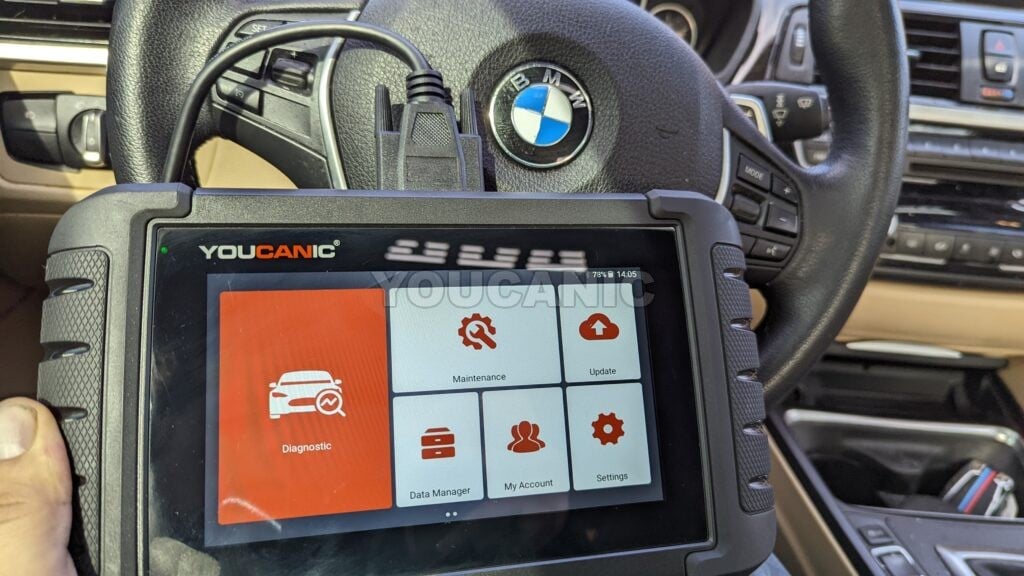
The good news is that BMW instrument cluster KOMBI modules can be diagnosed with a BMW scanner. The YOUCANIC UCAN-II Pro can read and clear fault codes in the engine and other control modules on supported vehicles.
If you are experiencing problems using a BMW scanner to read fault codes from the BMW KOMBI module. If any code shows PRESENT status, the problem needs to be fixed before the code can be cleared.
Procedure
- Plugin the OBD-II scanner into the diagnostic port under the dashboard.

- Turn on the ignition; don’t start the engine.
- Turn on the scanner and select your BMW chassis. Next, Select the Control Units menu.
- Select Instrument Cluster Module.
- Once you enter the Instrument Cluster module, you can do the following.
- Read Codes from Instrument Cluster Module
- Clear Codes from Instrument Cluster Module
- Perform Adaptations, Activations, Tests


You will need a diagnostic scanner to read, clear, and perform bi-directional tests on the BMW KOMBI module. You must verify that your scanner supports your BMW model and year.
Adaptations
This is a list of tests and sensor activations you can perform via the Instrument Cluster module.
- Reset Instrument Cluster
- The self-test instrument panel
- Check speed reading
TIP! Your scanner must be able to perform bi-directional tests to carry out these adaptations.
Live Instrument Cluster Data
In the Instrument Cluster Module, you can display live data and test various instrument cluster functions.
- Check operation of ODO reset button
- Check the coolant level
- Engine speed
- Onboard computer button
- Outside temperature display
- Outside temperature
- Parking brake operation
- Fuel tank level sensors 1 and 2
- Washer fluid level
Where to Repair BMW Instrument Cluster?

Before you decide to replace your BMW cluster, consider getting the existing unit repaired. If you can remove your cluster, you can send it to a service center that repairs BMW clusters.
Almost all BMW cluster problems can be repaired, including dead pixels, cluster completely dead, no backlight, stuck gauges, and even no communication with the cluster. BMW Instrument Cluster Repair Service
Most BMW cluster repair services range from $150 to $300 depending on the issue, while a new BMW cluster at the dealer costs over $1000.
Installing a BMW cluster
If your BMW cluster has failed and cannot be repaired, the only option is to replace it. You have two options: install a new BMW cluster by the dealer, which typically costs over $1000, or install a used BMW cluster and get it programmed to match your car’s miles.
New cluster
A new BMW cluster has the mileage set to 0. It must be coded for various items, including the correct mileage and specific options for your car.
At the dealer, a new cluster and programming can cost anywhere from $850 to $1500.
Used cluster
It is possible to install a used BMW instrument cluster. When installing a used BMW cluster, the main issue is that the mileage of the used cluster will not match the mileage on your car.
While your BMW dealer will not program a used BMW cluster, you can use a third party to perform mileage correction so that the miles on the used cluster match your car’s mileage.
You will need to send the used cluster to the service center. Make sure to provide mileage from your car and VIN.
Instrument Cluster Fault Codes
Many fault codes can be saved in BMW, the KOMBI module. Below are a few examples of codes stored in the BMW Instrument Cluster module.
- 931D KOMBI Undervoltage or Overvoltage
- E114A6: No message (status, ambient brightness), receiver KOMBI, transmitter JBE
- E11420: KOMBI: ServiceCall cannot be executed
What This Repair Costs
| Repair | Typical total cost |
|---|---|
| Fuse or wiring repair | $30 to $200 |
| Repair of your original cluster | $200 to $500 |
| Rebuilt exchange cluster, programmed | $350 to $800 |
| New cluster plus dealer coding | $900 to $2,000 |
| Diagnosis only at an independent shop | $120 to $250 |
Rough US estimates for planning, not quotes. Prices vary widely by model, parts brand and region, so get a written quote before committing.
Repairing your original cluster is the route that keeps your mileage and your key coding intact. That is why the price gap is this large, and why a scrapyard unit is usually a false economy on BMW.
When to Stop and Hand It Over
- The cluster needs coding or key alignment after replacement.
- The fault is intermittent and moves with vibration, which means a connector or a cracked joint and needs the unit on a bench.
- Several unrelated modules fault alongside the cluster, which points further upstream.
Confirming the Cluster Before Replacing It
A dead cluster might be the cluster, or it might be the supply to it, or it might be a bus fault that has taken the cluster offline along with other modules. Those are very different repairs. A generic OBD2 reader cannot tell you which, because it has no access to the body and cluster modules.
The YOUCANIC UCAN-II Pro reads all BMW modules and will show you whether the cluster is responding on the bus at all. A cluster that answers but reports internal faults is a repair candidate. A cluster that does not answer while everything else does points at supply or wiring, and that is a much cheaper day.
Where the cluster is confirmed, a repair of your original unit through a specialist such as Module Medics keeps your mileage and coding and avoids the dealer programming charge entirely.
Frequently Asked Questions
Why did my BMW instrument cluster stop working?
The cluster module itself is the most common cause, but check the cluster fuse and the battery first. A weak battery can make the cluster go blank.
Can I fit a used BMW instrument cluster?
Only with care. The cluster is locked to the VIN and stores the mileage, so a used unit has to be properly coded and the mileage handled legally.
Is it safe to drive with a dead BMW cluster?
Not really. You lose the speedometer, warning lights and fuel gauge, so you cannot see critical warnings. Get it fixed before driving far.
Check these troubleshooting and repair guides for more help on your BMW.





Absolutely helpful!